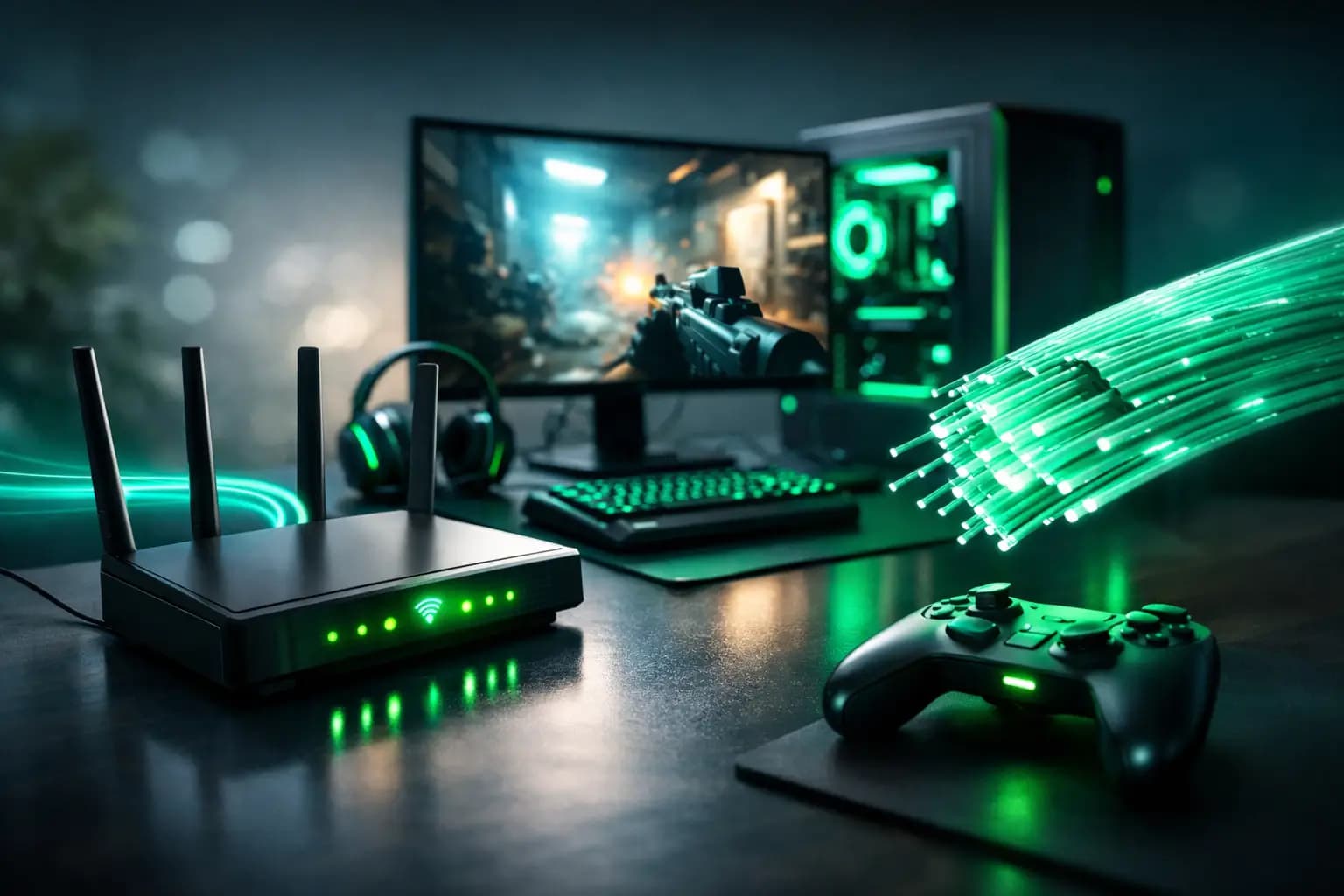
That moment when your ping spikes in the final round is usually blamed on “the internet”. Fair enough. But if you’re trying to find the best broadband for gaming UK households can actually rely on, the answer is not just “buy the fastest package and hope for the best”. Gaming broadband is about latency, stability, home set-up, and whether your provider is honest about what you’re really paying for.
Most broadband ads are obsessed with headline speed. Great for the billboard. Less useful when you’re rubber-banding across Warzone, lagging through EA Sports FC, or watching your mates move smoothly while your connection falls to bits. For gaming, speed matters, but not in the way most providers would like you to think.
What makes the best broadband for gaming UK players actually notice?
If you only remember one thing, make it this: low latency beats silly marketing numbers. Download speed helps with big game installs, updates and household streaming, but your in-game experience depends far more on responsiveness and consistency.
Latency is the delay between your device sending a signal and the server answering back. Lower is better. Jitter is the variation in that delay. Packet loss is when data simply fails to arrive. You can have a connection with decent download speeds and still get miserable gameplay if latency is high or unstable.
That’s why full fibre is usually the strongest choice for gamers. It tends to offer lower latency and better stability than older copper-based services. It also copes better when the whole house is online at once – someone streaming 4K in the lounge, someone else on a Teams call upstairs, and you trying to hold a clean connection in the middle of it all.
Upload speed matters more than many people realise too. If you stream your gameplay, upload clips, use voice chat constantly, or live in a busy household, weak upload can become the hidden bottleneck. Symmetric full fibre, where upload and download speeds are matched or closer together, is particularly useful here.
Speed matters, but only up to a point
Let’s kill off a common myth. You do not need gigabit broadband just to play online games. Most online gaming uses relatively modest bandwidth. What hammers your connection is everything around the game – downloads, patches, cloud saves, Twitch streaming, Discord, and everyone else’s devices.
For a solo gamer in a quiet household, a solid full fibre package at moderate speeds can be enough. For a family home with multiple devices, smart TVs, remote working, and a console that decides to download a 90GB update right before bedtime, faster packages start to make much more sense.
So what sort of speed should you look at? Roughly speaking, 100-300 Mbps is plenty for many gaming households if the connection is stable. 500 Mbps and above gives you more breathing room, especially in busier homes. Multi-gig speeds are brilliant if available, but they’re not a magic wand for lower ping. They are more about capacity, convenience and future-proofing than instant gaming superiority.
In other words, don’t overpay for a giant speed tier if the line quality, router and support are poor. Fast on paper is easy. Fast when it matters is the bit worth paying for.
Full fibre vs part-fibre for gaming
This is where the fine print starts earning its keep. Not all “fibre” broadband is the same.
Part-fibre connections, often sold as fibre broadband, still rely on copper for the last stretch into your home. They can be perfectly usable, but they are generally more vulnerable to slowdowns, interference and variable performance. For casual gaming, they may do the job. For competitive play, streaming, or homes with lots going on, they are less convincing.
Full fibre runs fibre all the way to the property. That usually means better stability, lower latency and speeds that are far less dependent on distance from the cabinet. If you’re serious about getting the best broadband for gaming in the UK, full fibre should be at the top of your list whenever it’s available.
There is a catch, of course. Availability still varies by postcode. The best option in one street may not exist in the next. That’s why a multi-network provider can be handy – rather than forcing one network into every situation, they can check what’s genuinely available and fit the package to your address.
Your router can ruin a great broadband line
This bit gets ignored far too often. You can buy a strong broadband package and still end up with rubbish gaming performance if your router is ancient, badly placed, or trying to push everything through overcrowded Wi-Fi.
If possible, use Ethernet for your console or gaming PC. It is usually the simplest way to cut out Wi-Fi interference and get a more stable connection. If running a cable is not practical, place your router centrally, away from thick walls and electrical clutter, and use the 5GHz band if your devices support it. In larger homes, mesh Wi-Fi can help, but for serious gaming, wired still wins.
Also keep an eye on what else is happening on your network. Automatic cloud backups, massive downloads and multiple video streams can all increase congestion. Good routers with proper traffic management can help, but the easiest fix is often basic household discipline. If someone starts downloading an entire game library during your ranked match, no broadband package in Britain is going to make that feel clever.
Price, contracts and support matter more than providers admit
Broadband is not just a technical decision. It’s a service decision.
A cheap deal stops looking clever when the monthly price jumps halfway through the contract, support keeps you trapped in a phone maze, and nobody can explain why your latency has gone haywire every evening. Gamers notice consistency, and that includes the provider.
Look for clear monthly pricing, sensible contract terms and support that can actually answer a straight question. If a provider hides inflation-linked rises in the small print, that matters. If they make switching awkward, that matters too. If support is impossible to reach when your line falls over the night before a tournament or a big release, that definitely matters.
This is one area where challenger providers often have the edge. They cannot rely on bloated brand recognition, so they have to be better at the basics – clearer pricing, sharper service, and fewer scripted non-answers. Giant, for example, leans hard into straightforward pricing and UK-based support, which is exactly the sort of thing that sounds boring until you need help quickly.
How to choose the right gaming broadband package
Start with your household, not the advert. Ask how many people are online, whether you game casually or competitively, whether you stream, and how often large downloads happen. A student flat with four heavy users needs something very different from a single-player household that mostly games in the evening.
Then check the connection type first, speed second. Full fibre with moderate speeds will often serve a gamer better than a faster-looking part-fibre package with shakier real-world performance. After that, consider upload speed, router quality, contract terms and support reputation.
It also pays to be honest about your own set-up. If you game over weak Wi-Fi in a back bedroom, changing provider may help, but not as much as moving to Ethernet or improving your home network. Plenty of people blame the ISP for problems that start two rooms away from the router.
Best broadband for gaming UK homes: the realistic answer
The best broadband for gaming UK buyers should look for is usually full fibre, with low latency, stable performance, decent upload, fair pricing and support that does not treat you like a nuisance. Beyond that, it depends.
If you are a competitive player, prioritise latency, wired connections and provider reliability over flashy speed claims. If your whole household is online all day, buy enough bandwidth to absorb the chaos. If you stream or upload regularly, pay close attention to upload speeds rather than obsessing over download alone.
And if a provider’s whole sales pitch is one giant speed number, read that as a warning sign. Gaming performance is not built on hype. It is built on a stable line, a sensible set-up and a provider that is not making life harder than it needs to be.
The smartest switch is rarely the noisiest one. Pick the broadband that stays out of your way, keeps your ping under control, and does not sneak surprises onto the bill. That is when the game feels fair again.