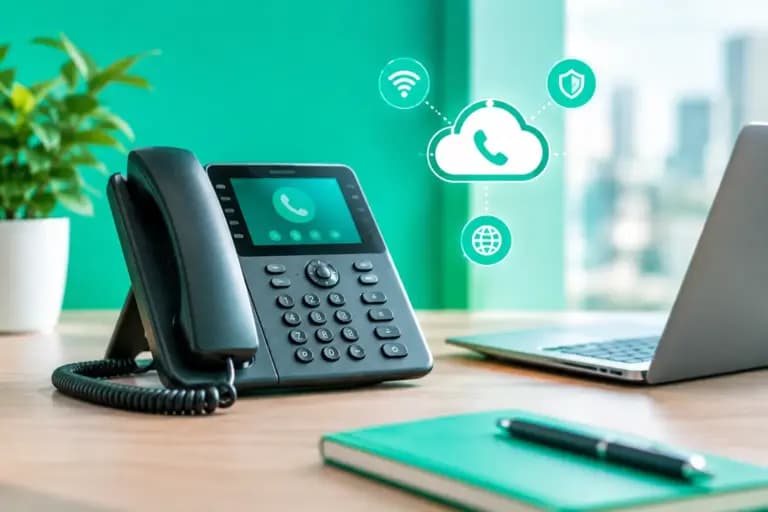
Missed calls rarely look dramatic. They look like a customer ringing while you’re on-site, in the van, halfway through payroll, or already speaking to someone else. Then they ring the next firm on Google. That is exactly where a virtual landline for small business starts to make sense – not as a flashy bit of telecoms jargon, but as a cleaner way to stay reachable without being chained to a desk phone.
For plenty of small firms, the old setup no longer fits. Copper landlines are fading out, teams are mobile, and customers still expect a proper business number, quick answers and a voicemail that does not sound like it was recorded in a cupboard in 2017. A virtual landline gives you the business presence of a fixed number, but routes calls through the internet or mobile devices instead of a traditional physical line.
What a virtual landline for small business actually is
Strip away the sales fluff and the idea is simple. A virtual landline is a telephone number that is not tied to one handset in one office. Calls can be sent to your mobile, a desktop app, a VoIP handset, a laptop, or several people at once depending on how you want the setup to work.
That matters because most small businesses do not operate from one neat reception desk anymore. Electricians, estate agents, salons, consultants, cafés, clinics and growing online retailers all need different things from their phone service. Some want one published number that follows the owner everywhere. Others want a main number with call routing, voicemail, opening hours and separate team extensions.
The key point is this: customers still call a landline-style business number, but you get far more control over where those calls go.
Why small businesses are moving away from old landlines
The old landline model did one job reasonably well. It rang in one place. For a lot of firms, that is now the problem.
If your business runs across multiple locations, uses hybrid staff, or relies on one person picking up everything from sales calls to supplier queries, a fixed line can become a bottleneck. You either miss calls or start forwarding them in clunky, expensive ways. Neither feels particularly modern.
A virtual setup is usually more flexible and often easier to scale. Need another user? Add one. Need calls to ring both the office and your mobile? Fine. Need out-of-hours voicemail sent by email so you can decide what is urgent? Also fine. You are not paying for the privilege of being stuck.
There is also the wider shift in UK telecoms. Traditional analogue services are being retired, and businesses that leave phone changes to the last minute tend to get caught between deadlines, rushed decisions and poor-value contracts. Sorting it earlier gives you more choice and fewer headaches.
The practical benefits of a virtual landline
The biggest win is credibility. A proper business number still matters. Customers are often more comfortable calling a recognised local or national business number than a random mobile, especially for first contact. It gives your business a more established feel, even if your team is small.
The second win is flexibility. Calls can follow your working day rather than dictating it. If you’re out meeting clients, you do not vanish. If someone on your team is off sick, calls can route elsewhere. If you work partly from home, nobody needs to know or care.
Then there is control. Features like call forwarding, hunt groups, voicemail-to-email, time-based routing and recorded greetings are not just nice extras. They help small firms look more organised than their size might suggest. That can make a genuine difference when you are competing with larger businesses.
Cost can be another advantage, but this is where honesty matters. A virtual landline is not always automatically cheaper in every scenario. If you need lots of advanced features, hardware, or high call volumes, the monthly spend can vary. But for many SMEs, it removes the cost and hassle of maintaining old-school fixed line infrastructure while giving them tools that would once have been reserved for bigger operations.
Where a virtual landline works best
A one-person business can benefit just as much as a team of twenty. In fact, sole traders often feel the difference fastest because they are the ones juggling everything.
If you are a tradesperson, it lets you publish a business number without plastering your personal mobile everywhere. If you run a small office, it can tidy up how calls are handled between departments or team members. If you have more than one site, it gives customers one clear number and a more joined-up experience.
It also suits businesses that are growing awkwardly – that stage where you are too busy for a single mobile, but not ready for a full-blown corporate phone system. A virtual landline sits nicely in that middle ground.
What to check before you buy
This is where people get tripped up. Not every service that calls itself a virtual landline offers the same thing, and some providers are very good at hiding costs in the fine print.
Start with call routing. Can you send calls to mobiles, desktops and multiple users? Can you set business hours? Can you change settings quickly, without needing an engineer and a week of back-and-forth?
Next, look at number options. If having a local presence matters, check whether you can choose an area code that fits your trading area. If you already have a business number, ask whether it can be ported across. Losing a number that customers already know is a needless own goal.
Then ask about support. This bit gets overlooked until the moment something goes wrong. A virtual phone system is only convenient while it works properly. If call quality drops, routing breaks, or number porting stalls, you want a provider that actually answers the phone rather than hiding behind ticket queues and scripted apologies.
Pricing needs a proper look too. Beware very cheap headline rates that balloon once you add users, call bundles, setup fees or basic features that should have been included from the start. Straightforward monthly pricing is not glamorous, but it is a lot better than discovering your telecoms bill has started freelancing.
Virtual landline vs mobile-only setup
Some small businesses wonder whether they should skip all this and just use mobiles. Fair question.
A mobile-only setup can work if your call volume is low and the business is very simple. It is quick, familiar and often fine in the early days. But it usually falls short once you need shared call handling, a more professional first impression, better reporting, or any separation between personal and business communications.
That does not mean mobiles disappear from the picture. In many cases, they become part of the virtual setup. The difference is that customers call your business number, and the system decides where the call goes. You keep the convenience of mobile working without making the business look improvised.
Virtual landline vs traditional office phone system
A traditional office phone system can still suit some businesses, especially if everything happens from one premises and there is a strong reason to keep physical desk phones throughout. But it is often less flexible and more cumbersome to adapt.
A virtual approach usually makes more sense for firms that want to move quickly, avoid unnecessary hardware and support remote or mobile working. That is especially true for smaller businesses that need practical tools rather than telecom theatre.
There is a trade-off, though. Because the service depends on internet connectivity, call quality and reliability are tied to the strength of your broadband or mobile data in the places you use it. That is not a reason to avoid it. It is a reason to make sure your connectivity is solid enough to support it.
How to tell if your business is ready
If customers complain that they cannot get through, if calls are being missed because one person is tied up, or if your current number setup feels messy and personal rather than professional, you are probably ready already.
The same goes if you are hiring, opening another location, moving premises, or trying to look more established without taking on unnecessary cost. A virtual landline is often one of those upgrades that seems small until it removes daily friction.
And that is the real point. It is not about pretending to be a bigger business. It is about making it easier for people to reach you, and easier for you to respond properly.
For small businesses, good telecoms should do the boring bits brilliantly. Calls should go where they need to go, customers should not hit dead ends, and pricing should not read like a trap. That is why a virtual landline is worth a proper look. Done well, it gives you the kind of flexibility modern businesses actually need – and none of the nonsense they do not.