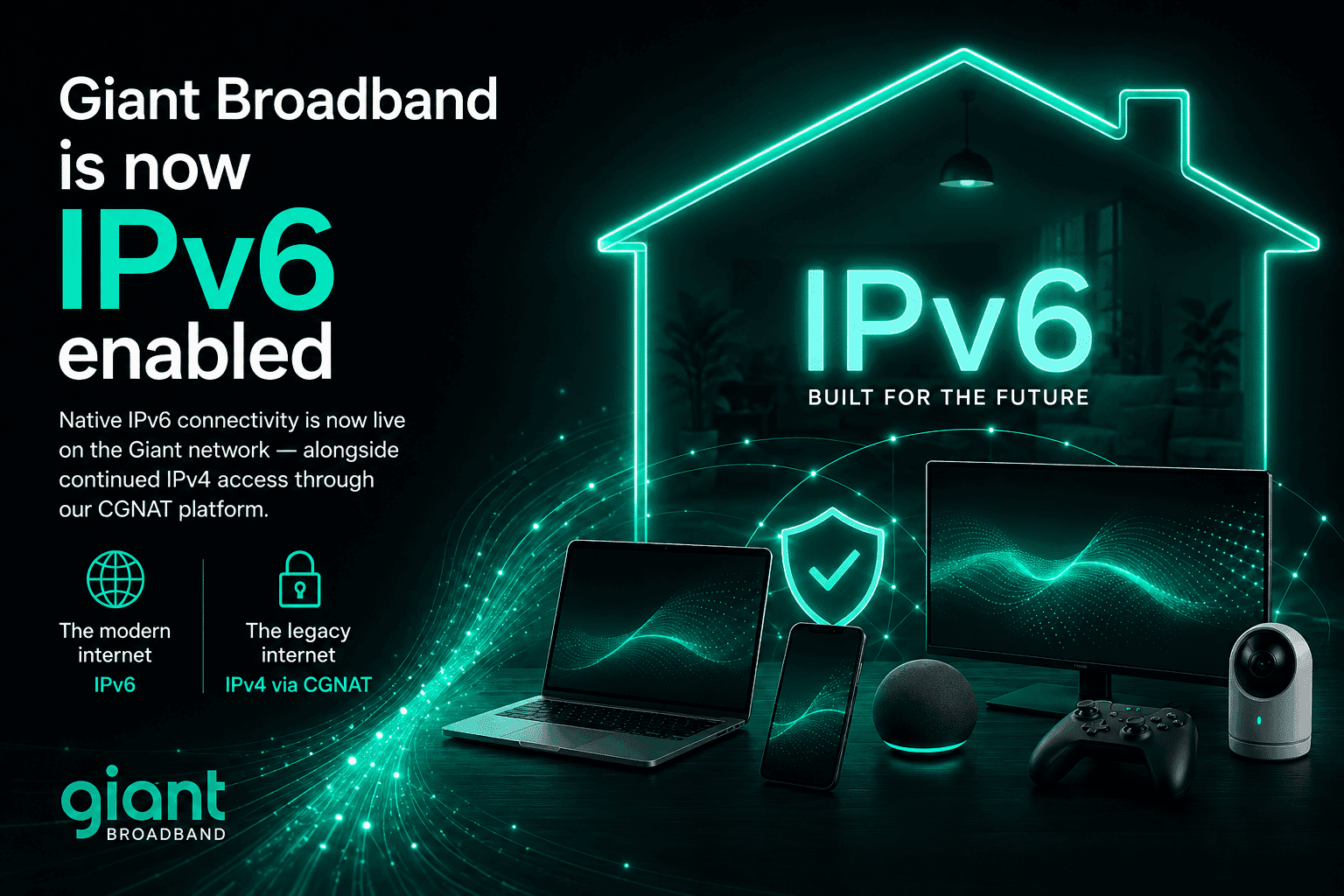
Giant has deployed native IPv6 across its broadband network, giving customers modern IPv6 connectivity alongside continued IPv4 access through our Carrier-Grade NAT platform.
The internet is running out of room.
IPv4 — the addressing system that has powered the internet for decades — provides around 4.3 billion possible addresses. That sounded enormous when IPv4 was designed. Today, with billions of phones, computers, televisions, consoles, routers, servers and smart devices connected to the internet, it isn’t nearly enough.
The long-term answer is IPv6.
And Giant Broadband is now IPv6 enabled.
IPv4 and IPv6, together
We aren’t switching IPv4 off.
Instead, Giant broadband connections can use both generations of the Internet Protocol.
For IPv4 connectivity, residential customers continue to use Giant’s Carrier-Grade Network Address Translation (CGNAT) platform. CGNAT allows multiple customers to efficiently share our pool of public IPv4 addresses while maintaining compatibility with websites, applications and services that still rely on IPv4.
Alongside that, we’ve now deployed native IPv6 connectivity.
When a website or online service supports IPv6, compatible devices on a Giant connection can communicate using IPv6 directly. When something still requires IPv4, IPv4 remains available through our CGNAT infrastructure.
For most customers, there’s nothing to configure and nothing they need to understand. Their devices simply use the appropriate protocol.
Why IPv6 matters
IPv6 isn’t simply “IPv4 with longer addresses”.
It was designed for an internet containing vastly more connected devices than IPv4 could ever accommodate.
An IPv4 address might look like:
185.123.45.67
An IPv6 address might look like:
2a12:abcd:1234:5678::1
The address space available with IPv6 is enormous: 128 bits rather than IPv4’s 32 bits.
That means the internet no longer needs to depend indefinitely on increasingly scarce IPv4 addresses and layers of address sharing simply to connect new devices.
For Giant, deploying IPv6 is part of building a network designed for where the internet is going — not just where it has been.
So why do we still need CGNAT?
Because the internet hasn’t moved to IPv6 overnight.
There are still websites, applications, devices and networks that depend on IPv4. Removing IPv4 completely would therefore cause compatibility problems.
CGNAT helps solve the shortage of IPv4 addresses during this transition.
Instead of assigning a dedicated public IPv4 address to every residential broadband connection, our network can translate connections from multiple customers through a managed pool of public IPv4 addresses.
IPv6 addresses the problem differently by providing an address space large enough for modern internet growth.
Running the two together gives us the best of both worlds:
- IPv6 for the modern internet and the long-term future of IP connectivity.
- CGNAT IPv4 for compatibility with the enormous amount of the internet that still uses IPv4.
Customers don’t have to choose between them.
Does this make my broadband faster?
IPv6 isn’t a new broadband speed tier, so enabling it doesn’t suddenly turn a 500 Mbps connection into a 1 Gbps connection.
What it does improve is the underlying way Giant connects customers to the wider internet.
Modern operating systems, browsers and applications are designed to work with IPv4 and IPv6. Where IPv6 connectivity is available end-to-end, traffic can use IPv6 without requiring IPv4 CGNAT translation.
The result is a Giant network that is better prepared for the continuing growth of IPv6 across the internet.
What about customers who need a public IPv4 address?
CGNAT is perfectly suitable for normal internet use, but we know it isn’t suitable for absolutely everyone.
Customers running servers, specialist VPN configurations, CCTV systems or services requiring unsolicited inbound IPv4 connections may need a dedicated public IPv4 address.
That’s why Giant continues to provide public and static IPv4 options for services where they’re required.
We also offer our L2TP tunnelling service, which can provide a Giant static public IPv4 address and native IPv6 connectivity over compatible broadband connections — including connections supplied by another ISP.
IPv6 isn’t being used as an excuse to remove advanced networking options.
It’s another one.
Building the Giant network for the next generation
Giant already delivers broadband across multiple UK fibre networks, with speeds reaching up to 8 Gbps in supported areas.
But building a modern ISP isn’t only about increasing the number printed on a speed test.
The systems behind the connection matter too.
Deploying IPv6 alongside our existing IPv4 CGNAT infrastructure is another step in modernising the Giant network and reducing our long-term dependence on increasingly scarce IPv4 address space.
IPv4 isn’t disappearing tomorrow.
IPv6 isn’t something we’re waiting for tomorrow, either.
It’s live on Giant.