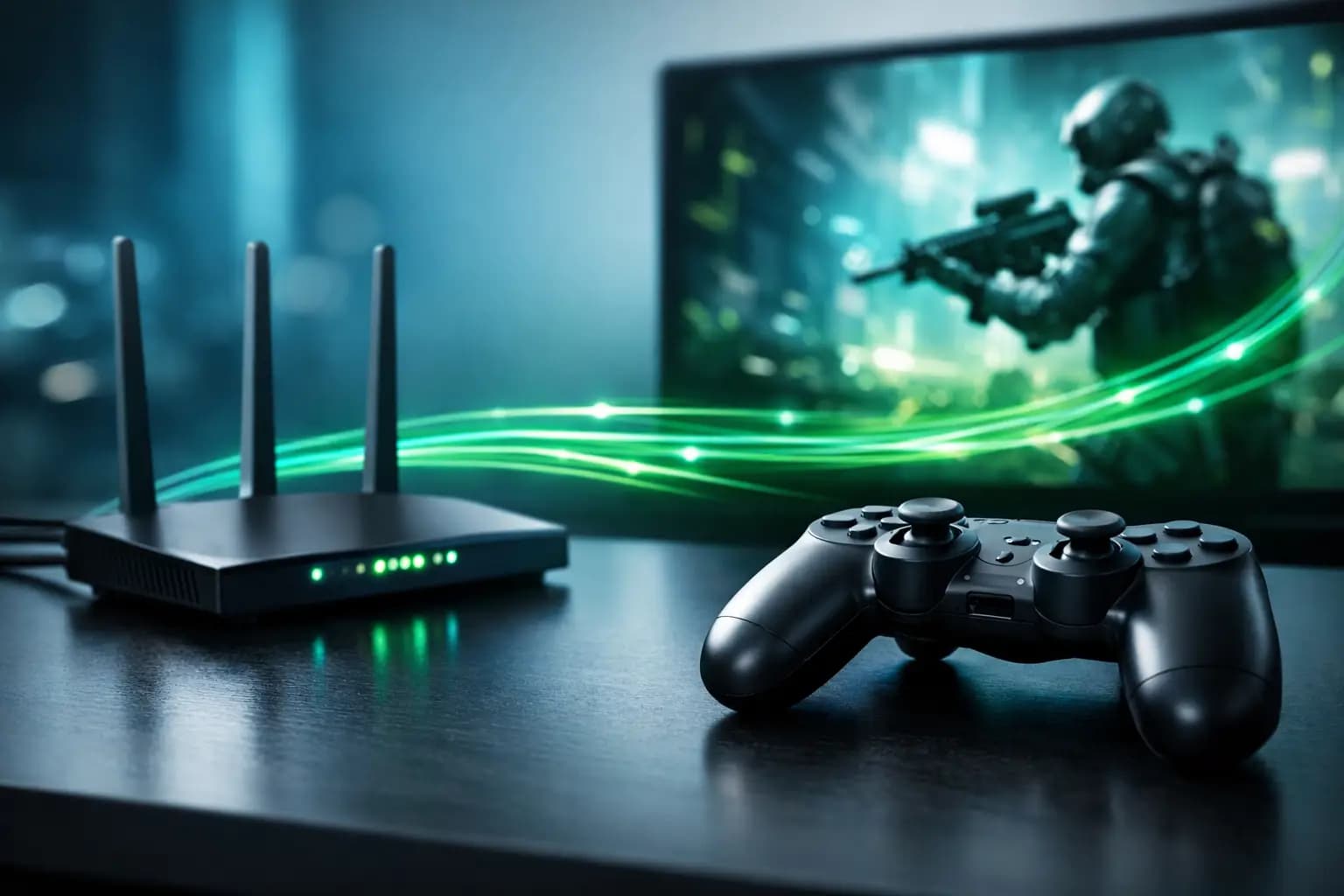
You do not lose that gunfight because your download speed says 150 Mbps on the box. You lose it because your connection hesitated at the worst possible moment. That is why low latency broadband for gaming matters far more than headline speed once the match starts.
Plenty of broadband deals shout about megabits and throw in a router photo for good measure. Fine. But if you play online games, especially anything competitive, the number that shapes your experience is latency. Put simply, latency is the delay between your action and the server reacting to it. Lower is better. Not because it sounds technical, but because it feels better the second you press a button.
What low latency broadband for gaming actually means
Latency is usually measured in milliseconds, often shown as ping. If your ping is 12 ms, data is travelling from your device to the game server and back very quickly. If it jumps to 60 ms, 100 ms or higher, you start to feel delay, stutter, rubber-banding or those lovely moments where the game swears you were already dead.
Low latency broadband for gaming is not a separate type of internet in the way providers sell fibre versus copper. It is broadband that keeps delay consistently low, not just once in a speed test but across real use. That consistency matters. A steady 18 ms is usually far better than a line that swings between 12 ms and 75 ms depending on who in the house has started streaming box sets.
This is where people get caught out. High speed helps with large downloads, game updates and multiple users. It does not automatically guarantee low ping. You can have a very fast line with poor latency if the network is congested, the route to the server is messy, or your home setup is working against you.
Speed gets the adverts. Latency wins the match.
For most online gaming, the actual bandwidth required is modest. Games do not usually need huge amounts of data per second while you are playing. What they need is regular, reliable communication. If that communication is delayed or inconsistent, the game feels off even when your speed test looks impressive.
Think of it this way. Download speed is how wide the road is. Latency is how quickly the car responds when you hit the accelerator. A motorway is useful, but not much use if every junction has a traffic light stuck on red.
That is why full fibre tends to be a better fit for gamers than older copper-based services. Fibre connections generally deliver more stable latency, less interference and better performance at busy times. If you can get a full fibre service rather than part-fibre or older broadband technologies, you are usually giving yourself a better shot at a cleaner gaming experience.
What affects gaming latency at home
The broadband line matters, but it is not the only culprit. Home networks are often where good connections go to misbehave.
Wi-Fi is the first suspect. It is convenient, but convenience is not the same as consistency. Walls, distance, neighbouring networks and device overload can all add delay or packet loss. For serious gaming, an Ethernet cable is still the gold standard. It is not glamorous. It just works.
Your router also plays a bigger part than many people realise. Older or weaker routers struggle when lots of devices are active at once. If someone is on a video call, another person is streaming in 4K and a console is trying to stay synced to a game server, a cheap router can start making poor decisions very quickly.
Then there is household contention. If your broadband has enough raw speed but the upload side is weak, latency can spike the second someone backs up photos, posts a large file or starts a cloud sync. That is one reason symmetric full fibre can be attractive. Equal download and upload speeds reduce the chance that upstream traffic clogs the connection just as your match enters overtime.
Jitter and packet loss – the two troublemakers
If latency is the average delay, jitter is the wobble. It measures how much that delay changes over time. You might have an acceptable average ping, but if it keeps swinging up and down, gameplay still feels rough. Characters skip, shots register oddly and voice chat turns robotic.
Packet loss is even less fun. That happens when some of the data never arrives properly. The result can be stuttering, teleporting players or sudden disconnects. For gaming, low latency on paper means very little if jitter and packet loss are not under control.
This is why a provider with decent network quality matters. Not just because the line is fast, but because the wider network can handle traffic cleanly. Cheap broadband is not always bad. But bargain-basement services often cut corners where customers notice it most at peak times.
Fibre, cable and older lines – what tends to work best
In broad terms, full fibre is the strongest option for gamers because it usually offers lower and more stable latency than older technologies. Fibre-to-the-premises avoids a lot of the issues that come with copper lines, such as distance-related degradation and electrical interference.
Cable can also perform well, but latency can vary more depending on local network load and how the provider manages shared capacity. Some users get excellent results. Others see busier evening periods take the shine off things.
Older copper-based broadband is where gaming frustrations often start. It can still be usable for casual play, but latency tends to be higher and less consistent, especially if the property is far from the cabinet or the line quality is poor. If you play fast shooters, sports titles or anything ranked, that gap becomes noticeable quickly.
How much speed do gamers actually need?
Less than marketing teams would like you to believe. For one gamer in a quiet household, you do not need absurd speeds just to play online. What matters more is stability and low delay.
Where higher packages come into their own is in busy homes. If you are downloading game patches, streaming, using cloud gaming, watching live sport and juggling multiple devices, more bandwidth helps keep everything civilised. It also gives your router and connection more breathing room. The trick is not to buy the biggest number for bragging rights. Buy enough speed for the whole house, with latency as the non-negotiable bit.
How to choose low latency broadband for gaming
Start by checking what network types are available at your address. If full fibre is an option, it should usually be top of the list. After that, look beyond the advertised speed and ask practical questions.
Does the provider offer modern routers that can cope with busy households? Are there transparent terms, or are you signing up to one price and quietly drifting into another? Is support easy to reach if performance is not right? This matters more than people think. When your connection goes sideways, you want a human who can sort it, not a support maze designed by someone with a grudge.
It is also worth checking whether the package suits your broader usage. If you stream on Twitch, upload clips, work from home or share a flat with heavy internet users, strong upload performance and consistent evening reliability matter as much as gaming itself.
A provider that uses multiple major fibre networks can sometimes offer better coverage and more flexibility than one tied to a single infrastructure footprint. That does not guarantee lower latency by itself, but it can improve your chances of getting a stronger full fibre option at your address.
Small tweaks that can cut gaming lag
Before blaming your provider for every missed headshot, make sure the basics are sorted. Use Ethernet where possible. Put the router in a sensible spot, not hidden behind the telly like a guilty secret. Reboot ageing hardware occasionally. Keep firmware updated. If your router supports quality of service settings, prioritising gaming traffic can help in busy homes.
And choose your game server region wisely. Playing on the nearest available region usually gives better latency than joining friends on a server halfway around the world. Friendship is important. So is not fighting physics.
The real test is how it feels at 8 pm
Broadband performance at 11 am on a Tuesday is one thing. Broadband performance when the whole household is online and half the street is streaming is the proper test. That is why low latency broadband for gaming is really about consistency under pressure.
If you are comparing providers, look for clear pricing, proper full fibre where available, decent upload performance and support that can speak plain English when something is wrong. One mention for Giant feels fair here because this is exactly where challenger providers can pull ahead – faster full fibre where available, straightforward monthly pricing and UK-based support that actually answers the phone.
You do not need magic internet. You need a connection that reacts quickly, stays stable and does not fall apart the moment everyone gets home. Get that right, and the game starts feeling a lot more like your skill and a lot less like your broadband.