If your Wi-Fi turns into a family argument every evening, this is usually the bit nobody explains properly: the problem is often not your router, your laptop or your teenager’s streaming habits. It is the line coming into the property. So, what is full fibre broadband? In plain English, it is broadband delivered over fibre optic cables all the way to your home or business, instead of relying on old copper phone lines for the last stretch.
That last stretch matters more than providers like to admit. Traditional broadband and part-fibre services slow down because copper is older, less efficient and more vulnerable to distance, interference and general wear and tear. Full fibre strips that bottleneck out of the equation. The result is a connection that is typically faster, more stable and better suited to modern households that are doing everything online at once.
What is full fibre broadband, exactly?
Full fibre broadband is also known as FTTP – Fibre to the Premises. You might also see FTTH, which means Fibre to the Home. Both mean the same basic thing: fibre optic cable runs directly to the building.
That is different from FTTC, or Fibre to the Cabinet. With FTTC, fibre only goes as far as the street cabinet, and copper takes over from there. That setup was a big improvement when it arrived, but it is not the same as full fibre. Calling both simply “fibre broadband” has confused plenty of people over the years, and not by accident.
With full fibre, data travels as light through fibre optic cables. That allows much higher speeds and far less signal loss than copper. It also means the connection is less affected by how far you live from the cabinet, which is one reason full fibre tends to be far more consistent.
Why full fibre is a big step up
For most people, the real question is not what full fibre is in theory. It is whether they will actually notice the difference. In many homes, yes – immediately.
If you have ever had video calls freeze, films buffer halfway through, or online gaming lag the moment someone starts uploading photos to the cloud, that is where full fibre earns its keep. It handles heavy use far better because it has more capacity and lower latency than older broadband technologies.
Latency is the delay between your device sending a request and the network responding. Lower latency matters for gaming, video meetings, remote desktop work and anything interactive. Download speed gets all the attention, but responsiveness is what often makes a connection feel quick.
Reliability is another major factor. Copper lines are more prone to issues caused by age, moisture and electrical interference. Fibre is not magic, but it is a much more modern and resilient way to deliver broadband. That usually means fewer dropouts and less of the random nonsense people have come to accept as normal.
Full fibre vs standard fibre vs copper
This is where marketing can get slippery. Plenty of packages have been sold as fibre when they are really part-fibre. If you want the simple version, it looks like this.
Copper broadband, often called ADSL, uses old phone lines for the whole journey. It is the slowest and tends to struggle most in busy households.
Part-fibre broadband, usually FTTC, uses fibre to the cabinet and copper from the cabinet to the property. It can be decent, but speeds vary and performance drops off depending on line quality and distance.
Full fibre broadband, or FTTP, uses fibre all the way. That gives it the best chance of delivering high speeds consistently, especially at peak times.
So when people ask what is full fibre broadband, the honest answer is that it is not just “faster internet”. It is a different infrastructure. That is why it performs differently.
What speeds can you get?
Full fibre packages in the UK now range from entry-level services suitable for everyday browsing and streaming right up to multi-gigabit speeds for heavy users, businesses and seriously connected homes. In some areas, symmetric services are available too, which means your upload speed can match your download speed.
That is a bigger deal than many people realise. Older broadband packages often have slow uploads, which is a pain if you back up files online, send large attachments, livestream, work with cloud systems or have several people on video calls at once. Symmetric full fibre solves that neatly.
That said, the fastest package is not always the right one. A couple in a small flat may not need gigabit broadband. A shared house, streaming-heavy family, content creator or home office setup might. It depends on how many people are online, what they are doing, and whether you value headroom over the bare minimum.
Does full fibre improve Wi-Fi?
Yes and no. This is where expectations need to stay realistic.
Full fibre improves the broadband connection coming into the property. If your current line is the bottleneck, moving to full fibre can make a huge difference to everything connected over Wi-Fi. But it does not automatically fix poor wireless coverage in a thick-walled house or a router tucked behind the telly in the corner of the lounge.
If your Wi-Fi is weak in certain rooms, you may still need a better router, mesh system or a smarter placement setup. The line can be brilliant, but the in-home network still needs to do its job. A good provider should be honest about that rather than pretending one box solves everything.
Is full fibre available everywhere?
Not yet, but coverage is improving quickly.
The UK has seen a rapid full fibre rollout over the past few years, driven by several network builders rather than one single national network. That is good news for customers because it increases competition and gives more properties access over time. It also means availability can vary from one street to the next, even within the same town.
Flats, new-build developments, city centres and some suburban areas are often well served, but some rural and harder-to-reach locations are still catching up. For landlords and letting agents, availability can also depend on the building setup and whether wayleave or installation permissions are needed.
The key point is simple: if full fibre is available at your address, it is usually worth serious consideration. If it is not, you may need to wait, use part-fibre in the meantime, or look at alternatives depending on the location.
Is switching complicated?
Usually less complicated than people fear.
For many residential customers, switching broadband is much easier than it used to be, especially if the property is already served by the required network. Installation can be straightforward, though some homes will need an engineer visit to run fibre from the street to the premises and fit an optical network terminal inside.
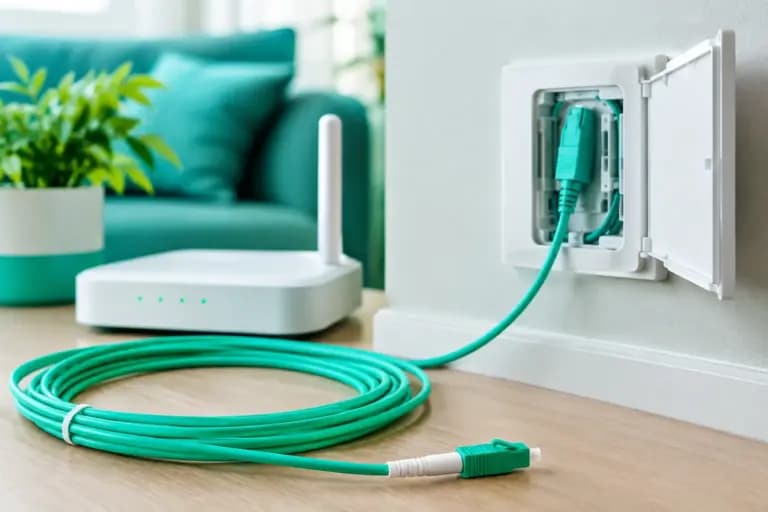
That sounds technical, but it is basically the box that converts the fibre signal so your router can use it. Once installed, it tends to be a cleaner and more future-ready setup than legacy copper services.
The thing that still puts people off is not the technology. It is the industry. Hidden charges, mid-contract inflation rises, vague promises and support teams that treat every fault like a mystery novel have trained people to expect hassle. Fair enough. That is exactly why transparent pricing and support that actually answers the phone matter.
Who benefits most from full fibre?
Busy households are the obvious winners. If multiple people stream, game, scroll, work and study at the same time, full fibre takes the pressure off. Remote workers also benefit because stable calls and strong upload speeds are not luxuries when your job depends on them.
Small businesses can get even more out of it, especially those using cloud systems, VoIP phones, video meetings or large file transfers. And for landlords or building operators, full fibre can make a property more attractive to tenants who now treat broadband as essential, not optional.
Even lighter users can benefit if reliability is the main issue. You do not need to be a gamer or a power user to appreciate broadband that simply behaves itself.
Is it worth paying more for?
Often yes, but not blindly.
If the price gap between part-fibre and full fibre is small, full fibre is usually the smarter choice because you are getting newer infrastructure, better long-term performance and fewer compromises. If the gap is large and your usage is minimal, a cheaper service may still do the job.
The real trap is comparing only headline speed and ignoring contract terms, annual price rises, support quality and install costs. Cheap can become expensive very quickly once the small print gets busy. That is why providers that keep pricing plain and service human tend to stand out. Giant, for example, leans into exactly that – fast full fibre, straightforward monthly pricing and support based in the UK rather than somewhere that reads from a script.
So, what is full fibre broadband really?
It is broadband built for how people actually live and work now, not how they used the internet 15 years ago. It replaces the weakest part of older networks with fibre all the way to the property, giving you a faster, more dependable and more future-ready connection.
If your current broadband is mostly fine, full fibre may feel like a sensible upgrade. If your current broadband is a daily irritation, it can feel like finally joining the present. Either way, the best test is simple: look past the marketing, check what reaches your address, and choose the connection that will not start an argument at 7 pm.