Your broadband can look fast on an advert and still fall apart when someone starts a 4K stream, another person joins a video call and your game decides now is the moment for a 90GB update. That is where full fibre vs part fibre stops being telecom jargon and starts affecting your actual evening.
The short version: full fibre is the better connection technology. It runs fibre-optic cable all the way to your home, while part fibre uses fibre for only part of the journey and relies on older copper wiring for the final stretch. That last stretch is where a lot of speed, consistency and upload performance gets left behind.
Part fibre is not automatically bad. For light browsing and a modest household, it can do the job. But if you are choosing a new connection, work from home, game online, upload large files or have a home full of competing devices, the difference is worth understanding properly.
Full fibre vs part fibre: the core difference
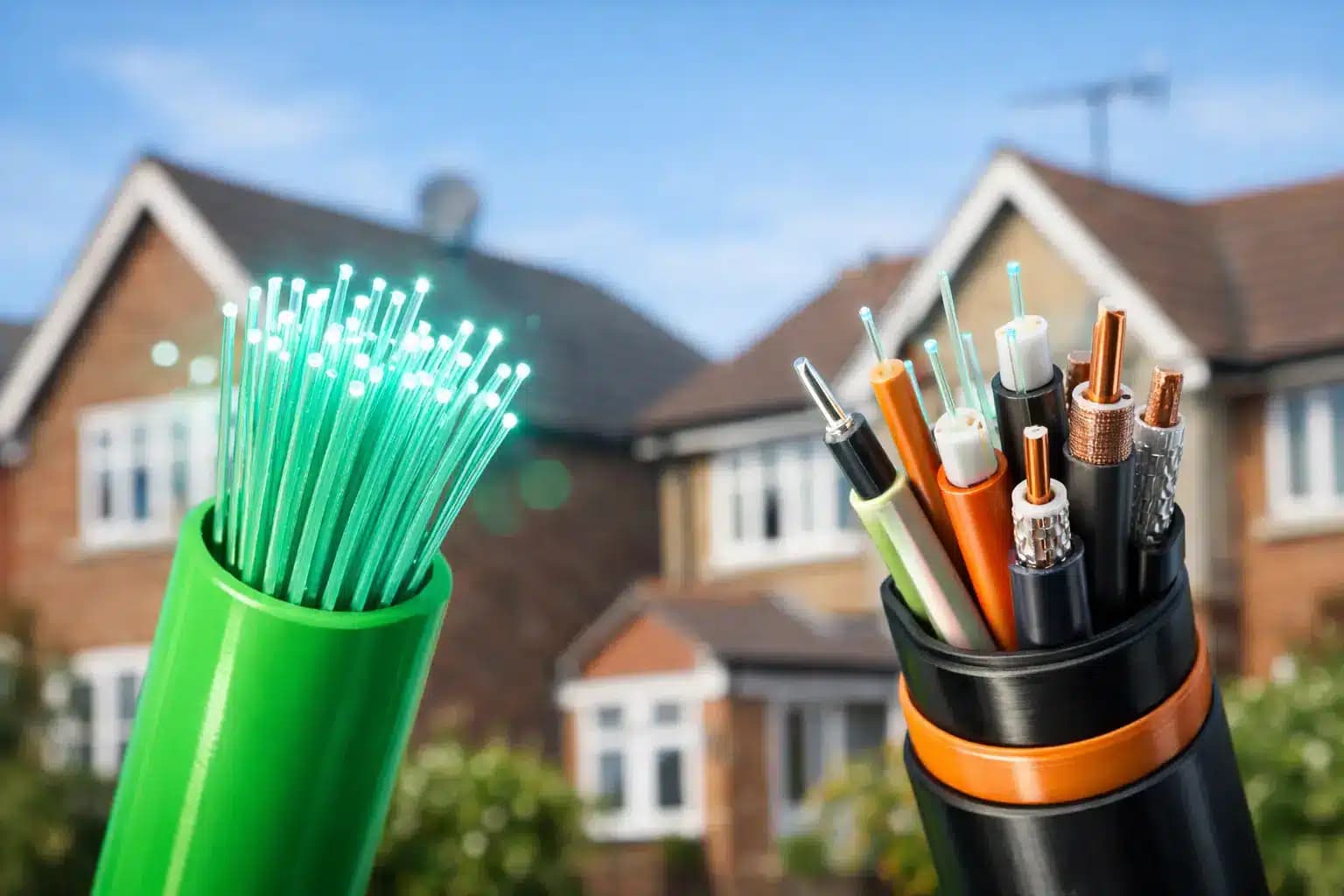
Full fibre, usually called FTTP or Fibre to the Premises, means fibre-optic cable reaches your property. Data travels as light through that fibre connection from the network to your home. It is built for high capacity, low interference and much faster speeds.
Part fibre usually means FTTC, or Fibre to the Cabinet. Fibre reaches the green street cabinet, then the signal travels over the existing copper telephone line between that cabinet and your home. It is an improvement on old-school ADSL, certainly, but it still carries the limitations of copper.
Think of it as a new motorway that narrows into an old country lane just before your front door. The motorway helps, but the bottleneck is still the lane.
| Feature | Full fibre (FTTP) | Part fibre (usually FTTC) | |—|—|—| | Cable to your home | Fibre optic | Copper from street cabinet | | Typical speed potential | Hundreds of Mbps to multi-gigabit | Usually tens of Mbps | | Upload speeds | Often much faster, sometimes symmetric | Usually far slower than downloads | | Distance impact | Minimal at normal residential distances | Performance drops further from the cabinet | | Reliability | Less affected by electrical interference | More vulnerable to line quality and interference | | Future capacity | Designed to scale | Limited by ageing copper infrastructure |
The labels can get slippery. Some providers use terms such as “fibre broadband” for both products because, technically, both use fibre somewhere in the network. Ask one direct question instead: does fibre come all the way into my property? If the answer is no, it is not full fibre.
Why the last stretch matters so much
Copper was originally designed for telephone calls, not a houseful of cloud backups, video meetings and streaming boxes. It can carry broadband, but it loses signal quality over distance and is more prone to electrical interference.
That is why two neighbours on part fibre can have very different results. The person closer to the cabinet may receive a respectable connection. The person at the end of the line can receive far less than the headline speed. Internal wiring, weathered connections and line faults can add to the fun. And by fun, we mean a support ticket.
Full fibre avoids that copper bottleneck. Its performance does not depend on how far your home is from a street cabinet in the same way, and fibre carries far more data with less degradation. This gives providers room to offer very high download speeds, stronger upload speeds and capacity that can keep pace with how homes now use the internet.
Download speed is only half the story
Most broadband adverts lead with download speed. Fair enough: it tells you how quickly you can stream, browse and download games. But upload speed matters more than it used to.
A part fibre connection might offer 70 Mbps down but only 18 Mbps up, sometimes less. That is fine for sending the odd attachment. It is less impressive when someone is backing up family photos, uploading design files, running a small business from the spare room or joining video calls while another person is gaming.
Full fibre plans often offer significantly better uploads. Some full fibre services are symmetric, meaning upload and download speeds match. A 500 Mbps symmetric service, for example, can upload at up to 500 Mbps as well as download at up to 500 Mbps.
That does not make every online task instantly faster. A website, game server or video platform may have its own limits. But it removes a major constraint at your end, which is exactly where you want it removed.
What about latency for gaming?
Speed and latency are different things. Speed is how much data your connection can move. Latency, often called ping, is how long data takes to travel between you and an online server.
Full fibre can deliver lower and more consistent latency than part fibre because the connection is less affected by copper-line noise and congestion at the local access network. That matters for competitive gaming, voice chat and video calls. It is not a magic wand, though. Your Wi-Fi setup, the game server location and the wider internet still play a part.
For the best result, connect a console, gaming PC or work desk by Ethernet where practical. Paying for fast full fibre then relying on a struggling router two rooms away is a bit like buying a sports car and fitting it with a wheelbarrow tyre.
Is part fibre ever the sensible choice?
Yes. If full fibre is not available at your address, part fibre can be the best fixed-line option available. A good FTTC service can comfortably handle browsing, HD streaming and everyday home use for one or two people. Price can also be a factor where a lower-speed connection genuinely meets your needs.
It may be enough if you live alone, mainly use the internet for email and television catch-up, and do not regularly upload files or have several devices active at once. There is no prize for buying more bandwidth than you will use.
But part fibre becomes a weaker long-term bet as household demand grows. A new job with home working, a teenager with a gaming habit, smart home devices, cloud storage and higher-quality streaming can change what “enough” looks like rather quickly.
The question is not only “Can it work today?” It is “Will it still feel good when everyone is online at once?”
Full fibre installation: what actually changes?
Moving from part fibre to full fibre normally requires an installation visit because a fibre cable needs to be brought to the property. An engineer may run a small cable from outside, install an optical network terminal inside and connect it to your router.
For many homes, it is a straightforward job. If you rent, you may need permission from your landlord for external work. Flats and managed buildings can be more complicated, particularly where the building has not yet been connected to a full fibre network.
The practical point is this: do not assume an address checker showing “fibre available” means no installation is needed. Check whether it says full fibre or FTTP, what equipment is included, and whether there are any access requirements.
How to compare broadband plans without the nonsense
Once you know full fibre is available, compare the details that affect your bill and your day-to-day experience. Start with the technology, then look at the speed tier and upload speed. Check the contract length, activation costs, router terms and what happens to the monthly price during your deal.
Be especially wary of price rises hidden behind language about annual inflation plus an additional percentage. A cheap starting price can become less charming once it starts climbing. Also check whether the provider gives a realistic estimated speed for your address, not merely a heroic “up to” figure.
Support deserves a look too. Broadband faults are rare until they happen to you at 8.45am before a presentation. A provider with accessible UK-based support and clear fault updates is worth more than hold music from a telecom giant pretending your call matters.
Giant offers full fibre across multiple UK networks where available, with plans reaching up to 8 Gbps in selected areas. The useful bit is not just the big number. It is having a choice of connection and speed that suits your home, without inflation-linked price rises quietly doing laps around your direct debit.
The better question to ask before you switch
Do not ask whether a package is called fibre. Ask what reaches your front door, what upload speed you get, and whether the contract remains fair after the introductory price ends.
If full fibre is available and your household depends on the internet for more than occasional browsing, it is usually the sensible upgrade. Check your address, choose a speed you will actually use, and give your home a connection that is ready for more than one person being online at a time.