
Rebuilt from the ground up, the new VoiceCloud brings together cloud telephony, artificial intelligence, intelligent automation, contact centre technology, unified communications and more than 120 business system integrations within a single, independently developed platform.
Giant Communications Ltd has announced the next generation of VoiceCloud, marking the most significant redevelopment of its cloud communications platform to date and establishing a new foundation for the company’s future in business communications.
The new VoiceCloud represents a complete transformation of the platform, extending from the underlying infrastructure responsible for processing telephone calls to the way businesses manage their communications, interact with customers and connect their everyday business applications.
Rather than continuing to expand upon its existing telephone system architecture, Giant has undertaken a comprehensive redevelopment of VoiceCloud, introducing an entirely new infrastructure, application architecture, customer experience, integration framework and suite of intelligent communications capabilities.
The result is a platform designed to bring together technologies that businesses have traditionally purchased, configured and managed separately.
Cloud telephony, contact centre management, artificial intelligence, business messaging, communications analytics, device provisioning, business system integrations and programmable communications are being brought together within a single ecosystem.
Importantly, Giant is bringing its existing customers with it.
Through a carefully managed migration programme, existing VoiceCloud customers will be upgraded to the new platform, with the transition designed to preserve their telephone numbers, extensions, call routing, voicemail, recordings and established telephone system configurations.
This is not simply a new version of a telephone system. It represents a new direction for VoiceCloud and a significant investment in the future of business communications.
More than a telephone system
Business communications have changed considerably over the past decade.
Telephone systems are no longer simply responsible for connecting callers to employees. Businesses increasingly expect their communications platforms to understand customer relationships, integrate with business software, support flexible working, automate repetitive tasks and provide meaningful information about every interaction.
However, achieving these capabilities has often required multiple suppliers, separate applications, specialist integrations and expensive enterprise communications products.
With the new VoiceCloud, Giant is taking a different approach.
The platform has been designed around the principle that communications should form part of the wider business, rather than operate independently of it.
A telephone call can become a customer record, a support ticket, an appointment enquiry, an AI-assisted interaction or the beginning of an automated workflow.
Businesses can determine how these interactions are handled, how information moves between systems and how their communications respond to changing circumstances.
From independent businesses operating a single telephone number to multi-site organisations managing complex contact centre environments, VoiceCloud has been designed to provide a common platform that can grow alongside the business.
The objective is to remove unnecessary complexity without compromising the flexibility and control that businesses require.
VoiceCloud, completely reimagined
Every major component of VoiceCloud has been reconsidered as part of the redevelopment.
The new platform introduces:
- A completely redesigned customer portal with comprehensive self-service management.
- A visual call flow builder with simulation, configuration history and version control.
- Natural-language telephone system configuration through Build with AI.
- A dedicated AI Assistant Studio for creating intelligent receptionists and business assistants.
- An expanded integration catalogue covering 121 business system providers.
- A telephone device catalogue encompassing 453 models from 15 manufacturers.
- Advanced contact centre capabilities, including skills-based routing and queue callbacks.
- Enhanced browser-based communications through VoiceCloud Web.
- Intelligent call recording, transcription and communications analytics.
- Comprehensive white-label reseller and wholesale partner management.
- Modern application programming interfaces and programmable communications.
- Enhanced security, fraud prevention and access controls.
- A distributed, region-based communications infrastructure.
- Centralised infrastructure management, monitoring and disaster recovery.
These capabilities have been developed around a shared technology foundation, allowing different areas of the platform to work together rather than operate as disconnected products.
New functionality will be introduced progressively as it completes production validation.
A platform rebuilt from the ground up
The redevelopment of VoiceCloud extends considerably beyond its customer-facing applications.
Giant has redesigned the platform’s underlying database architecture, telephone registration services, call-processing infrastructure, media handling, security systems, software deployment processes, monitoring, disaster recovery and operational management.
The new architecture is organised into independently operated regions, each designed to contain the services required to process communications without depending on another region for everyday telephone calls.
Within each region, dedicated components are responsible for telephone registration, call processing, media, contact centre queues, data storage and application services.
This approach reduces architectural dependency on individual telephone servers and creates a foundation for greater resilience, additional capacity and future geographic expansion.
The development programme has also introduced a new approach to software delivery, incorporating digitally signed releases, controlled rolling updates, automated health checks and rollback mechanisms.
Rather than treating the telephone system as a collection of individually managed servers, VoiceCloud has been designed as an integrated communications platform with centralised operational control.
This gives Giant greater flexibility over how the platform is developed, deployed, maintained and expanded.
The regional architecture also establishes the technical foundation for future international expansion, allowing communications infrastructure to be deployed closer to the businesses and markets it serves.
A completely new customer experience
One of the most visible changes for existing customers will be the introduction of a completely redesigned VoiceCloud customer portal.
The new portal has been developed around the tasks businesses need to perform, rather than the underlying technical configuration of a telephone system.
Customers will be able to manage their communications through a unified interface, including:
- Employees and telephone extensions.
- Telephone numbers and caller identification.
- Interactive voice response menus.
- Hunt groups and ring groups.
- Contact centre queues.
- Business opening hours and holiday schedules.
- Call forwarding and routing.
- Voicemail and shared mailboxes.
- Greetings, announcements and music on hold.
- Desk phones and connected devices.
- Call recordings and communications history.
- Business system integrations.
- User permissions and security settings.
- Artificial intelligence assistants.
Both simplified and advanced configuration experiences have been developed, allowing businesses to choose the level of control appropriate to their requirements.
A small business can manage its telephone system without needing specialist telecommunications knowledge, while more advanced organisations retain access to detailed configuration and routing capabilities.
The new portal has also been designed to make relationships between different parts of a telephone system easier to understand.
Administrators can identify which telephone numbers use a particular destination, which employees belong to a particular queue and how changes to shared configurations could affect the wider business.
The aim is to give businesses meaningful control over their communications without requiring them to become telecommunications engineers.
Proactive management, not just configuration
The new VoiceCloud introduces a proactive attention system designed to help businesses identify potential problems before they affect customers.
Rather than requiring administrators to search through individual settings pages, the platform can highlight issues that require attention.
These could include missing emergency service addresses, incomplete configurations, upcoming bank holidays, disconnected devices or other circumstances that may affect the operation of a telephone system.
The platform incorporates automated checks across multiple operational categories, with relevant information presented to customers, resellers and Giant’s own operations teams.
Businesses will also benefit from an integrated What’s New experience, providing visibility into platform improvements and newly introduced capabilities.
This represents a move away from telephone system portals that simply provide access to settings.
VoiceCloud is designed to help businesses understand their communications environment, identify opportunities for improvement and manage their services more effectively.
See exactly where every telephone call goes
Telephone system configuration has traditionally relied on individual menus, destinations, routing tables and settings that can make it difficult to understand how an entire telephone system operates.
The new VoiceCloud introduces a visual call flow builder that brings these elements together.
Businesses can see how incoming calls travel through their telephone system, from the moment a customer dials a telephone number to the point at which the call is answered, transferred, placed in a queue or directed to voicemail.
Call flows can incorporate a wide range of communications functions, including:
- Interactive voice response menus.
- Spoken-language menus.
- Hunt groups and ring groups.
- Contact centre queues.
- Business opening hours.
- Bank holiday schedules.
- Caller identification.
- External telephone numbers.
- Voicemail and announcements.
- Artificial intelligence.
- Business system integrations.
- Conditional routing.
- Custom destinations.
- Automated actions.
Individual steps can be configured directly within the visual environment.
Where a destination is shared by multiple telephone numbers, VoiceCloud can identify those relationships, helping administrators understand the wider implications of a configuration change.
The platform also introduces revision history and call flow simulation, allowing businesses to inspect and test routing configurations before publishing changes.
Previous configurations can be retained, providing a history of how a telephone system has evolved.
This represents a fundamental change in how businesses can interact with their communications.
Instead of relying on separate configuration screens and trying to understand how they connect, businesses can work with a visual representation of the complete customer calling experience.
Intelligent routing that understands your business
Traditional telephone systems typically make routing decisions based on relatively simple conditions, such as the telephone number dialled, the time of day or whether an employee is available.
The new VoiceCloud significantly expands the possibilities for intelligent call routing.
The platform incorporates more than 30 types of routing conditions, allowing businesses to design communications around a wider range of circumstances.
Calls can be handled differently according to opening hours, specific dates, caller information, employee availability, queue participation, previous interactions and information retrieved from connected business systems.
VoiceCloud also introduces enhanced bank holiday management, designed to accommodate the different public holiday schedules across the United Kingdom.
Businesses can build more sophisticated customer journeys without requiring individually developed telephone system scripts.
For example, an organisation could configure its communications to recognise existing customers, route particular enquiries to specialist teams or change how calls are handled when certain employees are unavailable.
The platform has also been designed to support temporary routing changes, allowing businesses to adapt their communications to unexpected circumstances without permanently altering their normal configuration.
These capabilities create opportunities for telephone systems that respond to the needs of the business rather than operating according to a fixed set of instructions.
Introducing Build with AI
One of the most significant developments within the new VoiceCloud is a natural-language configuration experience known as Build with AI.
The technology is designed to allow businesses to describe changes to their telephone systems using everyday language.

Rather than manually creating routing conditions, configuring destinations or navigating multiple settings pages, a customer could simply describe the outcome they want to achieve.
For example:
“Send all incoming calls to my mobile until five o’clock.”
“Close our offices on every bank holiday.”
“Create a new customer service queue and add these employees.”
“Route calls from existing customers directly to their account manager.”
“Explain why this customer was sent to voicemail yesterday.”
Build with AI is designed to interpret these instructions, understand the existing telephone system and prepare an appropriate configuration change.
The proposed changes are presented to the user for review before they are applied.
The assistant operates within the permissions of the person using it, with confirmation requirements, configuration history and audit records designed to keep businesses in control.
The technology also creates opportunities to simplify the initial setup of new telephone systems.
A business could describe its organisation, provide a list of employees, explain its opening hours and outline how it wants customers to be greeted.
VoiceCloud could then prepare a telephone system configuration for the business to review.
Rather than starting with an empty telephone system and configuring every individual component, businesses could begin with a configuration tailored to their requirements.
Giant has also developed a corresponding experience for wholesale partners, allowing authorised resellers to prepare configuration changes on behalf of their customers.
Build with AI represents a step towards a more accessible approach to managing business communications, where understanding how a telephone system should behave becomes more important than understanding how to configure it technically.
The feature will be introduced progressively following production validation.
Artificial intelligence that becomes part of your business
Artificial intelligence is becoming an increasingly important part of how businesses communicate with their customers.
However, many AI telephone products operate as standalone services, requiring businesses to forward calls away from their existing telephone system or establish separate integrations.
VoiceCloud takes a more integrated approach.
Artificial intelligence has been developed as part of the wider communications platform, allowing AI capabilities to interact with telephone numbers, call routing, customer information, business applications and human employees.
Rather than treating artificial intelligence as a separate destination for telephone calls, VoiceCloud has been designed to allow businesses to incorporate intelligent actions throughout their communications.
An AI component could identify the reason for a call, collect information, answer a question, classify an enquiry or assist with determining where a conversation should be directed.
Businesses can combine traditional telephone system functions with intelligent automation, retaining control over when artificial intelligence is used and when customers should speak directly to a person.
The objective is not to replace every human interaction.
It is to give businesses additional ways to manage communications, reduce repetitive administration and improve the experience of customers contacting them.
Introducing the VoiceCloud AI Assistant Studio
The new platform introduces a dedicated AI Assistant Studio, designed to allow businesses to create intelligent assistants that operate as part of their communications environment.
Businesses can define an assistant’s identity, responsibilities, voice, behaviour, knowledge and available actions.
An AI receptionist could be configured to greet callers, answer common questions, take messages, identify the reason for a call, retrieve relevant information or transfer a conversation to an appropriate member of staff.
Assistants can be connected to business knowledge bases containing documents, frequently asked questions, company information and other approved sources.
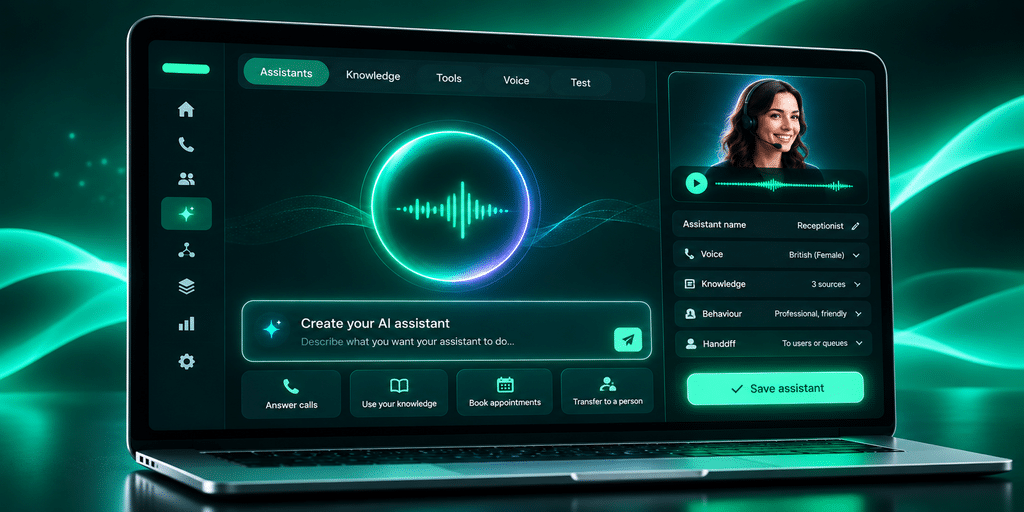
The platform has also been designed to support website-derived knowledge, appointment scheduling, caller identity checks and connections to external business systems.
Businesses can define what an assistant is permitted to discuss, what information it can access and when it should transfer a conversation to a human employee.
This creates opportunities for assistants tailored to individual organisations rather than relying exclusively on general-purpose AI services.
A business could create an assistant specifically for its reception, another for customer service and another for out-of-hours enquiries.
VoiceCloud’s AI architecture also supports the concept of multiple assistants working together, with different responsibilities and the ability to hand conversations between them.
Businesses are not limited to a single general-purpose receptionist.
They can design assistants around the different functions of their organisation.
AI assistants designed around individual industries
Different industries have different communications requirements.
A healthcare practice does not handle telephone enquiries in the same way as an estate agency, a vehicle dealership, a professional services business or a telecommunications provider.
VoiceCloud has been designed to accommodate these differences.
A dental practice could configure an assistant to answer routine enquiries, explain opening hours and assist with appointment requests.
An estate agency could use an assistant to establish whether a caller is interested in buying, selling or renting a property before directing the enquiry to the appropriate team.
A vehicle dealership could configure assistants around sales, servicing and general enquiries.
A professional services business could collect relevant information before transferring a caller to an appropriate department.
A trades business could use an assistant to establish the nature of an enquiry, collect contact details and pass information to an employee working away from the office.
A customer support organisation could identify an existing customer, establish the nature of their enquiry and provide relevant information to a human adviser.
These are examples of how artificial intelligence can become part of a business’s existing communications processes rather than operating independently of them.
The combination of intelligent assistants, call routing, knowledge bases and business system integrations creates opportunities for increasingly specialised communications experiences.
Giving businesses a choice of AI providers
Rather than developing VoiceCloud around a single artificial intelligence supplier, Giant has created a provider-independent AI architecture.
The platform incorporates an integration framework covering:
- Four language model integrations.
- Seven text-to-speech integrations.
- Four speech-to-text integrations.
- Three real-time conversational AI engines.
This approach is designed to provide greater flexibility over the quality, cost, latency and characteristics of AI-powered communications.
Different businesses have different requirements.
Some may prioritise the natural quality of an assistant’s voice. Others may require faster responses, particular language capabilities, regional accents or greater control over operational costs.
VoiceCloud’s architecture has been developed to accommodate these differences.
The platform is also designed to support both direct speech-to-speech conversations and more configurable approaches that combine speech recognition, language models and speech synthesis.
Businesses can choose from available voices and providers according to their requirements, with the platform designed to accommodate further developments in artificial intelligence without requiring a complete redesign of the communications system.
The platform also incorporates AI usage monitoring, budgets, provider fallback mechanisms and controls designed to help businesses manage their consumption.
Individual AI providers, voices and capabilities will become available as they complete production validation.
VoiceCloud Web: your communications wherever you work
The new platform establishes the foundation for the next generation of VoiceCloud Web.
VoiceCloud Web is designed to bring business communications into a browser-based environment, allowing employees to work with their existing business telephone numbers and communications services without depending exclusively on a physical desk phone.
The new platform’s web communications architecture encompasses telephone calls, voicemail, call history, messaging, contact information and meeting capabilities.
Employees can access relevant information about incoming callers alongside their communications interface, where supported by connected business systems.
This means a telephone call can be accompanied by useful customer information rather than simply an unfamiliar telephone number.
The platform also introduces a new architecture for browser-based telephone registration, incoming-call notifications and application connectivity.
These developments are designed to support businesses operating across offices, remote working environments and distributed teams.
VoiceCloud Web is intended to become a central communications workspace, bringing everyday business interactions together rather than requiring employees to move between separate applications.
Its enhanced capabilities will be introduced as compatibility and reliability testing is completed across supported devices and browsers.
VoiceCloud Connect: connecting communications with the software businesses already use
The redevelopment significantly expands the role of VoiceCloud Connect, Giant’s business communications integration platform.
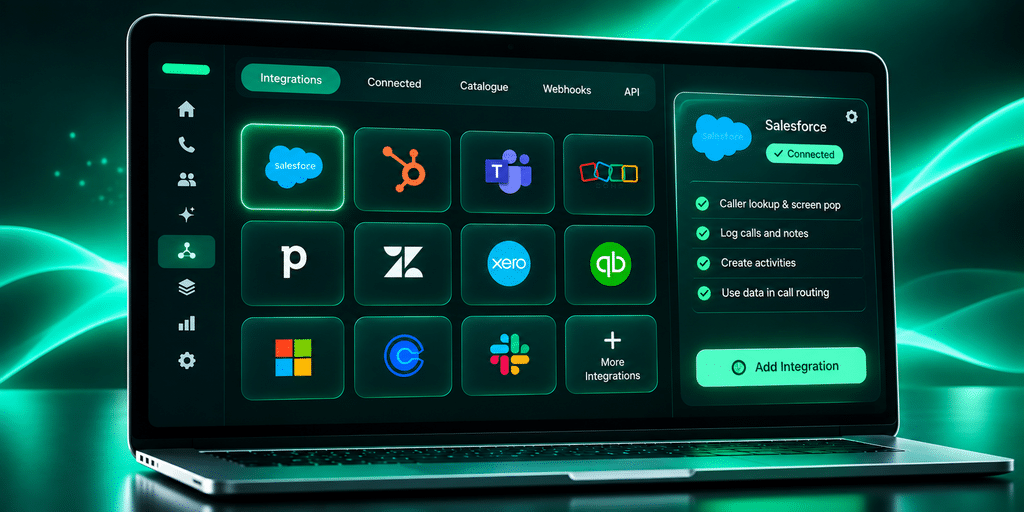
The new VoiceCloud integration catalogue encompasses 121 providers across a wide range of business software categories.
These include:
- Customer relationship management platforms.
- Help desk and customer support systems.
- Accounting applications.
- Healthcare and practice management systems.
- Appointment and booking platforms.
- Property management software.
- Estate agency applications.
- Trade and field service management systems.
- Industry-specific business applications.
Rather than operating independently of the software businesses already use, VoiceCloud has been designed to make those systems part of the communications experience.
Where supported, integrations can identify incoming callers, display relevant customer information, log telephone conversations and create records following missed calls.
Employees can spend less time manually searching for customer information and recording communications activity.
The new platform also introduces the ability to incorporate connected business information into call routing decisions.
For example, a telephone system could route an existing customer differently from a new enquiry, identify whether a caller has an appointment or use information from a support system to determine where a call should be directed.
This allows businesses to move beyond routing calls solely according to the telephone number dialled or the time of day.
Communications can instead respond to the relationship between the caller and the business.
Individual telephone numbers can also be associated with different connected business systems, creating greater flexibility for organisations operating multiple brands, departments or locations.
Individual integration capabilities depend on the external application, available permissions and production validation.
Enterprise contact centre technology
VoiceCloud introduces an expanded range of contact centre capabilities designed for businesses that handle customer enquiries at scale.
The new contact centre architecture includes dedicated queue-processing services, advanced agent management, skills-based routing, queue callbacks, live wallboards and enhanced reporting.
Skills-based routing allows businesses to organise employees according to their experience, responsibilities or specialist knowledge.
Rather than distributing every incoming call to the same group of employees, businesses can configure routing around the people best suited to handle particular enquiries.
Queue callbacks are designed to give callers an alternative to remaining on hold, allowing them to request a return call.
The platform also introduces enhanced abandoned-call notifications, configurable queue behaviour and supervisor capabilities.
Businesses can configure how long callers wait, how employees receive calls, what happens when a queue becomes unavailable and how callers are directed when their enquiry cannot be answered.
These capabilities can be combined with opening hours, intelligent routing conditions, business integrations and artificial intelligence.
Whether managing a small customer service team or a larger multi-department contact centre, VoiceCloud is designed to provide the flexibility to configure the customer experience around the organisation.
Live wallboards and meaningful reporting
Understanding what is happening across a communications environment is essential for businesses responsible for customer service.
VoiceCloud introduces enhanced wallboards and reporting capabilities designed to provide greater visibility into communications activity.
A dedicated wallboard designer allows organisations to create displays appropriate to their own operations.
Businesses can monitor relevant information about incoming calls, waiting callers, queue activity and employee participation.
Wallboards can be configured around particular departments or teams, helping businesses focus on the information that matters to their operations.
The platform also introduces expanded reporting capabilities, including saved reports, scheduled reporting and more detailed communications records.
Managers can use this information to better understand demand, identify recurring problems and make informed decisions about how their communications are configured.
Rather than providing information solely about the number of calls received, VoiceCloud is designed to offer greater insight into how those calls are handled.
More intelligent call recording and communications analytics
Telephone conversations contain valuable information, but that information is often difficult to retrieve once a call has ended.
The new VoiceCloud introduces an expanded approach to call recording, communications history and analytics.
Businesses can configure recording policies at different levels of their telephone system, manage retention periods and access recordings through the customer portal.
The platform includes an enhanced recording player, with waveform navigation and support for synchronised transcripts where enabled.
AI-powered transcription, summarisation and sentiment analysis form part of the wider communications intelligence architecture.
These capabilities are designed to help businesses understand customer conversations, reduce manual administration and improve the continuity of customer service.
Rather than requiring employees to listen to an entire recording to locate a particular discussion, searchable transcripts and summaries can provide a more accessible way to revisit communications.
VoiceCloud also incorporates more detailed call records, including individual call legs, failed call attempts, routing information and call outcomes.
This provides greater visibility into what happened during a telephone call and why.
Recording controls have also been expanded to accommodate different business requirements, including configurable retention, legal hold and payment-card recording pause functionality.
AI-powered analysis and live transcription capabilities will be introduced subject to provider validation and service availability.
A more connected voicemail experience
Voicemail remains an important part of business communications, particularly when employees are unavailable or organisations operate outside normal opening hours.
The new VoiceCloud introduces an enhanced voicemail experience, designed to make messages easier to access, manage and respond to.
Businesses can configure individual and shared voicemail boxes, manage greetings and access stored messages through the customer portal.
Where enabled, transcription and summarisation capabilities can provide additional ways to review voicemail messages.
The platform also introduces voicemail escalation, allowing businesses to configure additional actions when important messages are received.
These actions can include telephone calls, text messages or notifications to relevant employees.
This creates opportunities for voicemail to become part of a wider customer service process rather than simply a place where unanswered calls are stored.
Supporting more than 450 telephone models
Despite the increasing adoption of browser-based and mobile communications, physical desk phones remain an important part of many businesses.
The new VoiceCloud has been developed with a significantly expanded telephone device catalogue, encompassing 453 models from 15 manufacturers.
The platform also incorporates a unified zero-touch provisioning framework with integrations for eight manufacturer provisioning services.
Supported manufacturer integrations include:
- Yealink.
- Poly.
- Fanvil.
- Grandstream.
- Snom.
- Gigaset.
- Auerswald.
- Panasonic.
The new provisioning architecture allows configuration to be managed at multiple levels, including platform, reseller, customer and individual device.
Businesses and partners can configure telephone keys, ringing behaviour, wallpapers, screensavers and other supported device settings.
This provides greater flexibility for organisations that want to maintain consistent configurations across multiple offices or departments.
The platform also introduces enhanced status-light functionality for services such as call forwarding, do not disturb, queue participation and call parking.
Supported devices can provide greater visibility into the status of the wider telephone system, helping employees interact with communications services directly from their desk phones.
The expanded catalogue is designed to provide greater hardware choice and flexibility, with individual device compatibility and provisioning templates subject to validation.
Simplifying telephone provisioning
Configuring physical telephone devices has traditionally been one of the more time-consuming aspects of deploying and managing business communications.
VoiceCloud’s new provisioning architecture has been designed to simplify this process.
Businesses and partners can associate telephone devices with employees, configure supported settings and manage device configurations through the platform.
Configuration inheritance allows common settings to be established centrally while retaining the ability to customise individual devices.
A reseller could establish standard configurations across its customer base, while an individual business could apply its own branding, telephone key layouts and device preferences.
The platform also introduces enhanced provisioning security, with device-specific credentials and improved management of sensitive configuration information.
Supported telephone models can be configured to use backup communications servers, providing an additional mechanism for maintaining connectivity during infrastructure disruption.
This brings physical telephone devices more closely into the wider VoiceCloud ecosystem.
Communications beyond the telephone
VoiceCloud’s redevelopment also expands the platform’s wider communications architecture.
The platform incorporates support for business SMS, fax services, website communication widgets, callback requests and programmable communications.
Website widgets are designed to allow businesses to connect their websites with their communications environment, creating additional ways for customers to make contact.
These could include callback requests, communication buttons, business opening hours and other customer-facing information.
The architecture also establishes a foundation for further messaging channels and communications services.
Rather than developing each communications channel as a separate product, Giant is building them around a shared platform, allowing customer information, permissions, routing and operational controls to remain connected.
This approach creates opportunities for businesses to manage more of their customer communications through VoiceCloud over time.
Additional channels will be introduced progressively as development and production testing are completed.
Programmable communications for businesses and developers
The new VoiceCloud introduces a comprehensive application programming interface designed to allow businesses, partners and developers to connect their own applications to the platform.
The API has been developed around modern standards, including versioned endpoints and an OpenAPI specification.
VoiceCloud also incorporates a signed webhook framework covering 34 event types, with delivery monitoring and retry mechanisms.
These capabilities are designed to allow external applications to respond to communications events, automate workflows and interact with telephone system functionality.
A business could connect communications activity to an internal application, create its own reporting tools or develop workflows that respond to incoming calls and other events.
Software developers could build applications around VoiceCloud’s communications capabilities, while wholesale partners could integrate elements of the platform into their own operational systems.
The platform also introduces a Model Context Protocol server designed to allow compatible external AI applications to interact with VoiceCloud through controlled tools and permissions.
This establishes a foundation for new ways of connecting artificial intelligence with business communications.
Rather than limiting businesses to the functionality available within a particular interface, Giant is developing VoiceCloud as a platform that can be extended through integrations and programmable services.
Security built into the platform
Security has been a central consideration throughout the redevelopment of VoiceCloud.
The platform introduces two-factor authentication, granular permissions, encrypted credential storage, comprehensive audit records and enhanced fraud prevention.
Businesses can manage access according to the responsibilities of individual users, helping ensure that employees only have access to the information and configuration relevant to their role.
Account administrators can require additional authentication protections and manage access to sensitive communications functionality.
Changes to telephone system configurations are recorded, providing greater visibility over who made a change and when it occurred.
The same principle extends to changes made through support teams, wholesale partners and AI-assisted configuration.
The platform has also been designed around stronger management of sensitive information, including credentials used by telephone devices, external providers and connected applications.
VoiceCloud incorporates region-wide network protection and monitoring capabilities designed to identify suspicious activity affecting the communications infrastructure.
Security is not treated as a separate feature of the platform. It forms part of how VoiceCloud manages access, configuration, communications and operational services.
Enhanced telecommunications fraud prevention
Telecommunications fraud can have significant financial consequences for businesses and communications providers.
The new VoiceCloud incorporates a dedicated fraud prevention architecture designed to provide greater control over communications usage and risk.
The platform introduces configurable controls covering spending limits, high-risk destinations, call duration and suspicious communications activity.
These controls can be applied at different levels of the platform, allowing Giant and its wholesale partners to manage risk across their communications environments.
Businesses can also establish restrictions appropriate to their own requirements, helping reduce exposure to unauthorised or unexpected communications usage.
Monitoring and alerting capabilities are designed to help identify activity that may require further investigation.
The objective is to provide a more comprehensive approach to telecommunications security, combining preventative controls with greater operational visibility.
Designed around resilience and business continuity
Reliable communications remain fundamental to the operation of businesses.
The new VoiceCloud has been engineered around a distributed architecture designed to reduce dependency on individual servers.
Shared telephone registration allows the platform to locate connected devices across the regional infrastructure.
Dedicated call-processing and queue services provide a foundation for distributing communications workloads and recovering from component failures.
The regional database architecture introduces quorum-based operation, designed to prevent conflicting database changes during infrastructure failures.
The platform also incorporates controlled recovery mechanisms, automated health monitoring and operational safeguards.
Giant’s development programme has included laboratory testing of server failures, network partitions, database recovery and concurrent communications workloads.
Further production validation will take place as the platform is introduced to customers.
The objective is not simply to recover more effectively when a problem occurs, but to design the communications infrastructure around the expectation that individual components may occasionally fail.
This approach establishes a stronger architectural foundation for maintaining business communications as the platform continues to evolve.
A new approach to emergency communications
Emergency calling remains a fundamental responsibility for communications providers.
As part of the redevelopment, Giant has designed a dedicated emergency call routing architecture intended to reduce dependency on ordinary application and database services.
The platform incorporates enhanced management of emergency service addresses, with visibility into telephone numbers that require additional configuration.
Emergency routing has also been designed to prioritise the appropriate communications provider associated with a telephone number.
These developments form part of Giant’s wider commitment to building communications infrastructure around reliability, operational responsibility and business continuity.
Emergency calling arrangements will be subject to end-to-end carrier validation before customer migration.
Comprehensive backup and disaster recovery
The new VoiceCloud introduces a dedicated backup and recovery framework designed around the requirements of a modern communications platform.
Rather than relying solely on conventional server backups, the architecture incorporates multiple recovery mechanisms.
These include encrypted backups, database recovery, point-in-time restoration, protected backup storage and centralised recovery management.
A dedicated Restore Centre provides operators with tools designed to assist with the recovery of communications services and data.
The platform also incorporates storage health monitoring, backup verification and visibility into the condition of the systems responsible for protecting communications data.
Recovery procedures form part of the wider operational architecture, rather than being treated as an isolated administrative task.
These developments are intended to strengthen Giant’s ability to respond to infrastructure failures and recover services in a controlled manner.
Software updates designed around service continuity
Communications platforms must continue evolving while remaining available to the businesses that depend on them.
The new VoiceCloud introduces a software deployment architecture designed around controlled, incremental updates.
Rather than requiring every server to be updated simultaneously, the platform supports rolling releases, allowing updates to be introduced progressively across the infrastructure.
Software releases are digitally signed, with health checks and rollback mechanisms designed to identify problems during deployment.
The architecture also supports controlled handling of active communications workloads during maintenance.
This provides Giant with a foundation for delivering improvements more regularly while reducing the operational risks associated with major platform updates.
Customers will benefit from a platform designed to evolve continuously rather than relying exclusively on occasional large-scale upgrades.
A new approach to managing communications infrastructure
Alongside the customer-facing platform, Giant has developed a comprehensive operator console responsible for managing the VoiceCloud infrastructure.
The console brings together infrastructure management, server monitoring, regional topology, capacity planning, live communications activity, security, storage, backups, software releases and service incidents.
Operators can inspect communications activity, investigate individual calls, view routing information and identify the health of the components responsible for processing communications.
Detailed call tracing provides visibility into how a telephone call has moved through the platform, including the decisions made by its routing services.
Guided infrastructure management workflows have also been developed for tasks such as adding servers, expanding regional capacity, managing database membership and recovering services.
The infrastructure management architecture incorporates support for multiple cloud providers, creating greater flexibility over how future VoiceCloud capacity can be deployed.
This provides Giant with a foundation for expanding the platform without relying on a single infrastructure provider or a fixed deployment model.
The operator experience is designed to give Giant greater visibility and control over the entire communications environment, from the infrastructure processing a call to the configuration determining where it is routed.
Greater transparency over service performance
The new VoiceCloud incorporates an expanded approach to service monitoring and operational transparency.
The platform has been designed to monitor the health of its individual communications components, rather than relying exclusively on whether an entire server is available.
This provides greater visibility into the services responsible for telephone registration, call processing, media, storage, databases and application functionality.
An enhanced public service status experience is designed to provide customers with clearer information about the operation of the platform.
Incident management, service monitoring and operational reporting form part of the wider VoiceCloud architecture.
These developments are intended to support more effective investigation of service issues and provide customers with greater visibility into the communications services they rely on.
A complete wholesale communications platform
The next generation of VoiceCloud has also been developed with wholesale partners, telecommunications resellers and managed service providers in mind.
The platform introduces a dedicated reseller experience, designed to allow partners to deliver communications services under their own brand.
Partners can configure their own logos, colours, domains, customer-facing portals and communications templates.
They can manage customer accounts, telephone numbers, users, devices, call routing, service configurations and other aspects of their communications environments through a centralised portal.
The platform also introduces multi-level device configuration, allowing partners to establish standard telephone settings across their customer base while retaining the ability to configure individual organisations and devices.
Resellers can manage service plans, communications bundles, customer permissions and reporting.
The new architecture also supports reseller-controlled copies of recordings and voicemail in compatible external storage environments.
AI-assisted configuration has been designed to extend to the reseller experience, creating opportunities to simplify customer onboarding and ongoing telephone system management.
Rather than simply providing access to a hosted telephone system, Giant’s objective is to provide partners with a comprehensive communications platform through which they can develop their own services and customer relationships.
Your brand, your customers, your communications platform
The new VoiceCloud wholesale architecture has been designed to allow partners to maintain their own identity throughout the customer experience.
White-label capabilities extend beyond applying a logo to a customer portal.
Partners can establish their own customer-facing domains, branding, communications templates and welcome documentation.
Customer onboarding materials can reflect the reseller’s identity and contact information, allowing partners to maintain a consistent relationship with the businesses they serve.
The platform also provides delegated customer management, allowing authorised reseller employees to access and configure customer telephone systems according to their assigned permissions.
Changes made on behalf of customers are recorded, providing greater accountability across the communications environment.
Partners can manage their services centrally while retaining the flexibility to accommodate the individual requirements of each customer.
The objective is to give wholesale partners the tools to build and manage their own communications businesses without requiring them to develop the underlying telecommunications infrastructure themselves.
Bringing every VoiceCloud customer into the future
A fundamental part of the VoiceCloud redevelopment has been ensuring that existing customers can benefit from the new platform without having to rebuild their telephone systems.
Giant Communications has developed a dedicated migration framework specifically designed to transfer existing customer configurations, communications history and media into the new VoiceCloud environment.
The migration technology has been engineered to maintain synchronisation with the existing platform, validate customer configurations and compare call routing behaviour ahead of each customer’s scheduled transition.
Rather than undertaking a single platform-wide switchover, Giant will introduce the new VoiceCloud through a carefully managed, customer-by-customer rollout.
Existing telephone numbers, extensions, call routing, opening hours, voicemail, announcements and music on hold are intended to be preserved throughout the transition.
Historical communications data, including eligible call recordings and voicemail messages, will also be transferred subject to existing retention policies, media availability and migration verification.
Customers will receive advance notification of their migration, alongside information about their new portal, enhanced capabilities and any actions required.
Business continuity remains central to the migration programme, with individual configuration checks, controlled transitions and recovery arrangements forming part of the process.
For existing customers, the objective is simple: everything they rely on today, with an entirely new platform behind it and significantly more possibilities ahead.
The next generation of VoiceCloud is not a separate product that existing customers are being left behind to purchase.
It represents the future of VoiceCloud itself.
What existing customers can expect
For existing VoiceCloud customers, the transition has been designed to minimise disruption and avoid unnecessary changes to the way their businesses operate.
Customers will not be expected to manually recreate their telephone systems.
The migration programme is designed to carry across established configurations, including:
- Existing telephone numbers.
- Employee extension numbers.
- Interactive voice response menus.
- Hunt groups and ring groups.
- Contact centre queues.
- Business opening hours and holiday schedules.
- Call forwarding arrangements.
- Voicemail boxes and greetings.
- Announcements and music on hold.
- Telephone device configurations.
- Custom dialling codes.
- Eligible call recordings and communications history.
Where telephone devices require new provisioning, credentials or configuration, customers will receive relevant guidance.
Any unsupported equipment or configuration requiring individual attention will be identified as part of the migration preparation process.
Customers will receive information about their new portal and sign-in arrangements ahead of their transition.
Following migration, businesses will gain access to the new VoiceCloud environment and its expanded management capabilities.
The wider range of new features will become available progressively according to production readiness and individual service plans.
An ambitious investment in the future of communications
The redevelopment of VoiceCloud represents a significant investment by Giant Communications in its own technology, software development and communications infrastructure.
Every major component of the platform has been reconsidered, from the infrastructure responsible for processing telephone calls to the applications businesses use to manage their communications.
The new platform brings together technologies across telecommunications, software development, artificial intelligence, distributed infrastructure, data management and business automation.
By developing these capabilities around a shared technology foundation, Giant has established a platform designed to evolve continuously alongside the requirements of businesses and communications partners.
Developing its own communications platform also gives Giant greater control over its product roadmap.
New capabilities can be developed around customer requirements, emerging technologies and opportunities within the telecommunications industry.
The company can continue expanding VoiceCloud without relying exclusively on the development priorities of a third-party telephone system supplier.
This independence forms an important part of Giant’s wider technology strategy.
The redevelopment is not simply an investment in the communications technology businesses need today.
It is an investment in the technology they will need tomorrow.
Built in Britain, designed for the future
As a British telecommunications and technology provider, Giant Communications is continuing to invest in the development of its own communications technology.
The new VoiceCloud demonstrates the company’s commitment to building software and infrastructure that address the changing requirements of businesses and communications partners.
The regional architecture provides a foundation for future geographic expansion, while the platform’s integration and artificial intelligence frameworks create opportunities to introduce new services as technologies evolve.
Giant’s approach combines established telecommunications technologies with its own software, management systems, communications applications and intelligent automation.
This allows the company to benefit from mature industry technologies while retaining control over the wider product experience.
The objective is to develop a communications platform capable of serving businesses across different industries, organisational structures and markets.
A platform designed to keep evolving
The next generation of VoiceCloud establishes the foundation for continued development across multiple areas of business communications.
Future developments can build upon a shared platform rather than requiring separate products and disconnected infrastructure.
This creates opportunities for:
- Additional communications channels.
- More advanced artificial intelligence capabilities.
- Deeper industry-specific integrations.
- Expanded contact centre functionality.
- Further communications automation.
- Enhanced mobile and browser-based experiences.
- Additional programmable communications services.
- Expanded wholesale capabilities.
- Future geographic expansion.
Giant’s objective is to make advanced communications technology accessible to businesses without requiring the complexity traditionally associated with enterprise telecommunications systems.
VoiceCloud has been designed to evolve alongside the businesses that use it.
The introduction of the new platform is therefore not the conclusion of the redevelopment programme.
It is the beginning of the next chapter.
A message from Giant Communications
Callum Longworth, Director of Giant Communications Ltd, said:
“When we started developing the next generation of VoiceCloud, we knew we wanted to do considerably more than redesign a customer portal or add a handful of new features.
“We wanted to rethink the entire platform, from the infrastructure that processes a telephone call to the experience a business has when managing its communications.
“Businesses shouldn’t need to purchase several different products simply to make telephone calls, manage customer enquiries, integrate their business software and introduce artificial intelligence.
“We believe those capabilities should work together, and that businesses should have far greater control over how they use them.
“Developing our own platform gives us the freedom to decide how VoiceCloud evolves, respond to the requirements of our customers and build technology around the way businesses actually operate.
“We have deliberately designed the platform to be flexible. Whether a business wants a straightforward telephone system, a sophisticated contact centre, an AI receptionist or a fully integrated communications environment, we want VoiceCloud to provide the foundation for it.
“Most importantly, we’re bringing our existing customers with us. This isn’t about abandoning the platform our customers rely on or asking them to start again.
“It’s about taking everything they already use and building a much stronger foundation for what comes next.
“We also recognise that communications are fundamental to the operation of a business. Introducing new technology must never come at the expense of the services our customers depend on. That’s why the migration programme and production validation are such important parts of this redevelopment.
“We see VoiceCloud becoming considerably more than a business telephone system. It is becoming the communications layer that connects people, businesses, software and artificial intelligence.
“This is the beginning of a new chapter for Giant Communications, and we’re incredibly excited about what it allows us to build.”
Frequently asked questions
What is the new VoiceCloud?
The new VoiceCloud is a completely redeveloped cloud communications platform bringing together business telephony, contact centre technology, artificial intelligence, business integrations, programmable communications and customer self-service management.
It replaces the underlying technology of the existing VoiceCloud platform while establishing a foundation for new communications capabilities.
Is this a separate product?
No. The new platform represents the next generation of VoiceCloud.
Existing customers will be brought forward through a managed migration programme.
Will existing customers need to change their telephone numbers?
No changes to existing telephone numbers are intended as part of the migration.
The migration programme has been designed to preserve customers’ established telephone numbers and communications configurations.
Will customers need to rebuild their telephone systems?
No. Giant has developed a dedicated migration framework designed to transfer existing telephone system configurations into the new platform.
Customers will receive guidance where individual configurations or devices require additional attention.
Will existing desk phones continue to work?
The new VoiceCloud includes an expanded telephone device catalogue covering more than 450 models.
Individual device compatibility will be checked as part of migration preparation. Customers will be informed if their equipment requires additional configuration or replacement.
What happens to existing recordings and voicemail?
The migration programme includes the transfer of eligible historical call recordings, voicemail messages and other communications media, subject to existing retention policies, media availability and migration verification.
Will customers be able to manage their own telephone systems?
Yes. Comprehensive self-service management is a central part of the new VoiceCloud experience.
Customers will be able to manage their telephone system configurations through the new portal, according to their account permissions and service plans.
Does artificial intelligence automatically change telephone system configurations?
Build with AI has been designed to prepare proposed changes for review.
Changes require confirmation before being applied, and the assistant operates within the permissions of the person using it.
Will businesses be able to choose their AI providers?
VoiceCloud has been developed around a provider-independent artificial intelligence architecture.
Businesses will be able to choose from available providers and capabilities according to their requirements and service arrangements.
Will all new features be available immediately?
New capabilities will be introduced progressively as production validation is completed.
Availability will depend on individual service plans, device compatibility, external provider requirements and applicable usage charges.
Will wholesale partners benefit from the new platform?
Yes. The new VoiceCloud introduces a comprehensive reseller experience, including white-label portals, custom domains, customer management, centralised provisioning and expanded operational capabilities.
When will existing customers move?
Customers will receive individual notification ahead of their scheduled migration.
The rollout will be managed progressively, with further information provided directly to customers.
Availability and customer rollout
The next generation of VoiceCloud will be introduced through a phased rollout.
Existing customers do not need to make immediate changes to their telephone systems as a result of this announcement.
Individual migration information will be provided ahead of each customer’s scheduled transition.
New capabilities will be made available progressively as production validation is completed, with availability dependent on individual service plans, device compatibility, external provider requirements and applicable usage charges.
Further information about the platform, migration programme, new features and wholesale opportunities will be published through Giant’s website and customer communications.
Businesses and communications partners interested in learning more about the next generation of VoiceCloud can visit www.giant.net.uk.
About VoiceCloud
VoiceCloud is Giant Communications’ cloud communications platform, developed to bring together business telephony, intelligent call management, contact centre technology, artificial intelligence, business integrations and programmable communications.
Designed for businesses and communications partners, VoiceCloud provides a flexible foundation for managing customer interactions, telephone systems and connected communications services.
By combining advanced communications technology with comprehensive self-service management, VoiceCloud is designed to give businesses greater control over how they communicate, operate and interact with their customers.
About Giant Communications
Giant Communications Ltd is a UK telecommunications and technology provider based in Liverpool, delivering broadband connectivity, business telephone systems, mobile services and wholesale communications solutions.
Through continued investment in its own technology, software development and communications infrastructure, Giant is developing integrated services designed to make advanced communications more accessible to businesses and communications partners.
The company is focused on combining connectivity, communications and intelligent technology to support the evolving requirements of modern businesses.
For further information, visit https://giant.net.uk.