Your video call freezes just as you need to speak. The kids are streaming upstairs, somebody is downloading a game update, and the smart TV has picked that exact moment to buffer. When comparing fibre broadband versus 5G, the real question is not which technology sounds newer. It is which one keeps working when your household is actually using it.
Both can be seriously quick. Both can get you online without the old copper-phone-line nonsense. But they do different jobs, and the fastest headline speed is only part of the story.
Fibre broadband versus 5G at a glance
| What matters | Full fibre broadband | 5G home broadband | | — | — | — | | Connection type | Physical fibre cable to your property | Wireless signal from a nearby mobile mast | | Typical consistency | Very stable, especially at busy times | Can vary with signal strength and local demand | | Top speeds | Up to 8 Gbps where available | Often fast, but depends heavily on coverage and capacity | | Upload speeds | Often symmetric, so uploads can match downloads | Usually slower than download speeds | | Latency | Usually low and predictable | Can be low, but is more variable | | Installation | May require an engineer visit or fibre activation | Usually plug in the supplied router | | Best for | Busy homes, gamers, remote workers and businesses | Flexible setups, short-term needs and properties without fibre |
The short version: if you can get proper full fibre, it is usually the stronger long-term home connection. 5G is a clever alternative where fibre is not yet available, or where flexibility matters more than absolute consistency.
Speed is not just the number on the advert
A 5G connection can deliver impressive download speeds. In the right location, it may comfortably handle 4K streaming, video calls and everyday browsing. That is a massive step up from slow copper broadband.
But 5G is shared wireless capacity. Your router talks to a mobile mast, alongside mobile phones and other 5G home broadband customers in the area. At 8am, it may fly. At 8pm, when the street is watching football, gaming and scrolling at once, performance can change.
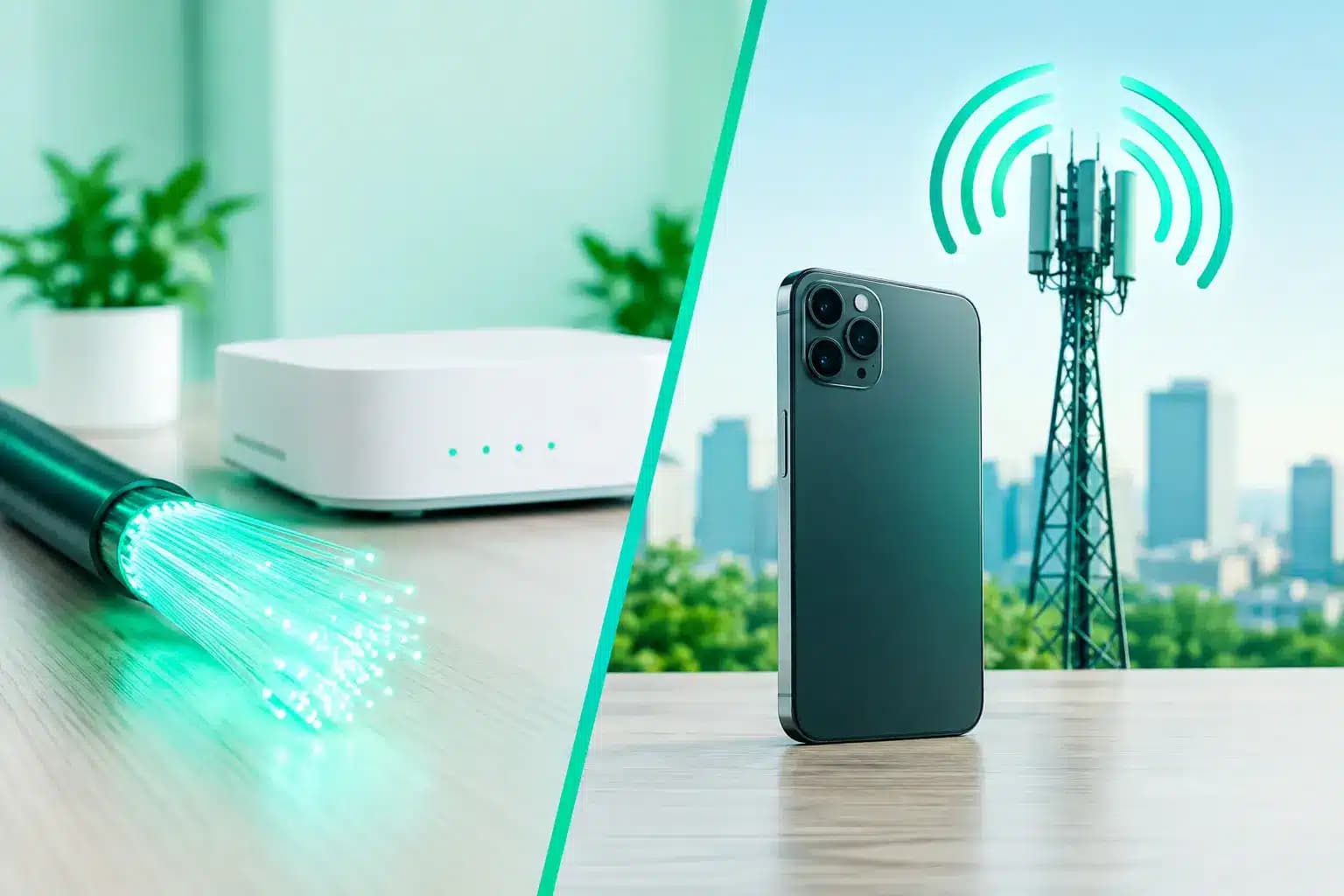
Full fibre is different. Data travels along fibre-optic cable directly to your property, rather than through the air from a mast. There is still shared network infrastructure further upstream, because no provider has a private internet for every customer, but the final connection is built for dependable high capacity.
That matters if several people use the connection at once. A fibre package with enough headroom does not need the house to take turns. Someone can be on Teams, someone else can stream in 4K, and a console can download a sizeable update without turning the evening into a family tribunal.
Download speed versus upload speed
Downloads get all the attention, but uploads are where fibre often pulls properly ahead. Uploading large files, backing up photos, hosting video calls and sending work to the cloud all rely on upload speed.
Many full fibre services offer symmetric speeds, meaning a 900 Mbps service can offer around 900 Mbps up as well as down. Availability and package details vary, but it is a meaningful advantage for creators, home workers and small businesses. 5G can offer decent uploads, yet they are typically less predictable and lower than download speeds.
Reliability: cables usually beat radio waves
Wireless is convenient. It is also at the mercy of physics.
A 5G signal can be affected by how far you are from the mast, the materials in your walls, where the router sits, local congestion and even changes to the network around you. One flat may get an excellent signal by the window, while the identical flat next door gets a less cheerful result.
This does not make 5G bad. It means you should test it properly before treating it as a permanent replacement for a fixed connection. Check the signal in the room where the router will live, not on your mobile phone while standing outside with one arm in the air.
Fibre has its own potential faults. A damaged cable, power cut or equipment issue can still knock any service offline. But under normal conditions, fibre is less exposed to day-to-day swings in performance. For homes that rely on connectivity for work, study, gaming or security devices, that predictability is worth more than a flashy peak-speed claim.
Is fibre or 5G better for gaming and video calls?
For competitive gaming, fibre is normally the easy winner because latency tends to be lower and more stable. Latency is the delay between your device sending a request and receiving a response. High speed does not automatically mean low latency. You can have a rapid 5G download and still see jitter – small, annoying changes in delay that can affect online matches and calls.
Fibre is also the safer bet for video meetings. A call needs consistent upstream capacity, not just a fast burst at the start of a speed test. If your job involves presenting, selling, teaching or interviewing online, fewer awkward freezes are a practical business benefit, not a luxury.
For casual gaming, browsing and occasional calls, a well-performing 5G connection may be absolutely fine. The difference becomes clearer when the connection is under pressure or the activity is time-sensitive.
Setup and flexibility: where 5G earns its place
This is where 5G can be brilliantly simple. In many cases, you receive a router, place it where the signal is strongest, plug it in and get connected. There is no waiting for external cabling or an engineer appointment. For a short let, temporary office, construction site or a property where fixed fibre has not arrived, that convenience is hard to argue with.
It can also be useful as a backup connection. A small business that cannot afford to be offline may use fibre as its main line and 5G as failover. If there is an issue with the fixed connection, essential devices can stay online through the mobile network.
Fibre needs a little more commitment at the start. Your address must be serviceable, and an installation may be needed if fibre has not already been brought to the building. Once it is in, though, you have a connection designed to stay put and handle growing demand.
Cost: compare the whole contract, not the opening offer
Do not compare broadband solely by the first monthly price. Check the contract length, setup charges, hardware fees, cancellation terms and whether the price can rise mid-contract. A cheap-looking deal with an inflation-linked increase hidden in the small print can stop looking cheap rather quickly.
5G home broadband may offer shorter commitments or more flexible terms, which is valuable if your circumstances could change. Fibre contracts can be longer, but may deliver better value per Mbps, particularly at higher speeds and for households that genuinely use the capacity.
Also check what happens after a service problem. A connection is only as good as the help available when it is not behaving. Clear communication and UK-based people who can actually answer the phone beat being passed around a scripted support maze.
Which connection should you choose?
Choose full fibre if you have access to it and need a dependable primary connection. It is the natural fit for streaming-heavy households, gamers, remote workers, smart homes, shared properties and businesses that send or receive large files. If symmetric uploads, low latency and stable performance matter, fibre is hard to beat.
Choose 5G if you need internet quickly, cannot get fibre yet, move frequently or want a flexible secondary connection. It can be a very good service in an area with strong coverage, but do not assume the experience will match a mobile speed test taken in a different part of town.
For most fixed homes, fibre is the infrastructure built for the long haul. Giant offers full fibre across multiple UK networks, which can mean more choice at more addresses without the usual big-provider theatre.
Before signing anything, check your address, think about how many people and devices use the connection at peak time, and ask how important an interrupted call or lagging game really is to you. Pick the service that handles your busiest hour, not the one that looks cleverest in a headline.