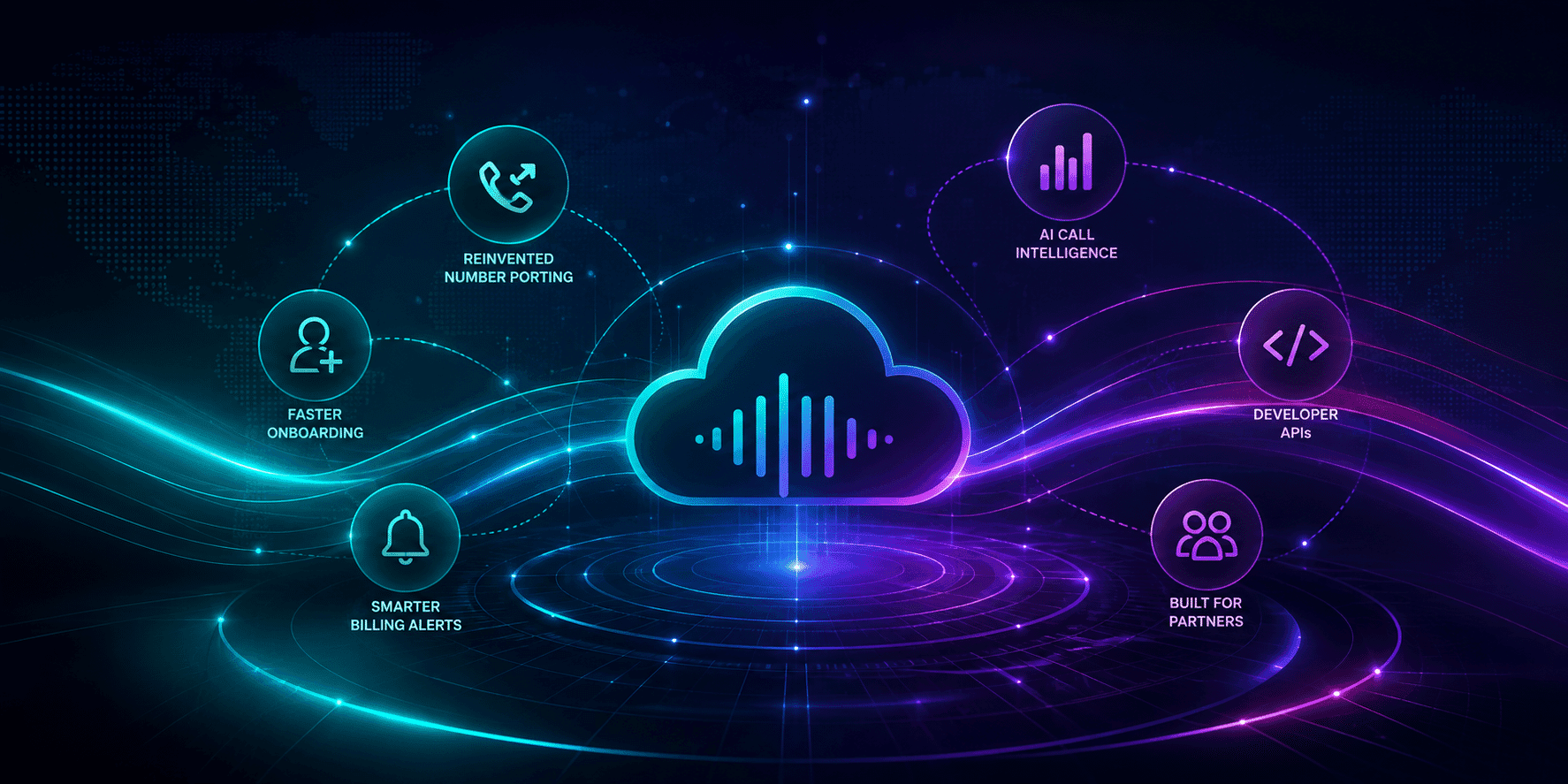
AI call intelligence was only the beginning. Giant Communications has spent the months since transforming the wider VoiceCloud platform — rebuilding call history, reinventing number porting, automating onboarding, introducing proactive spend monitoring and opening VoiceCloud to developers.
When VoiceCloud introduced AI call sentiment, the obvious feature was the ability to see how a conversation went without having to listen to the entire call.
But it also established a much bigger direction for the platform.
Take something that traditionally requires time, telecoms knowledge or manual work — and make it obvious.
Since then, Giant Communications has been applying that philosophy across VoiceCloud.
The result is considerably more than another collection of VoIP features.
The call log has been rebuilt around conversations rather than records. Number porting has been redesigned from beginning to end. New users can be provisioned automatically. Unusual spending can be spotted before the invoice arrives. And new APIs mean VoiceCloud functionality can increasingly live inside somebody else’s application altogether.
Here’s what’s changed.
The call log grew up
A traditional VoIP call log answers some fairly basic questions.
Who called? When? How long did it last? Was it answered?
VoiceCloud now goes much further.
Answered calls can carry an AI-generated sentiment assessment, making it possible to understand the general tone of a conversation without opening it.
Users can filter their history by sentiment to quickly surface conversations that went particularly well — or those that might deserve another look.
Where VoiceCloud has analysed a call, AI-generated summaries and transcripts can sit directly alongside the call record.
That changes the purpose of call history.
Instead of simply being a record that a conversation happened, it starts becoming a searchable record of what happened during the conversation.
Search what was actually said
VoiceCloud’s call search no longer has to begin with a telephone number.
Transcripts can be searched too.
If someone remembers discussing an overdue invoice, appointment, cancellation or product but can’t remember exactly who they spoke to, the words from the conversation can help find the call.
VoiceCloud also combines this with much richer filtering.
Call history can be narrowed by direction, outcome, location, sentiment and date range from a single interface.
Columns can be shown or hidden depending on what’s important to the user, while dates, durations, costs and caller information have all been redesigned to be easier to understand at a glance.
And when there isn’t a recording, VoiceCloud no longer pretends otherwise.
Playback controls are only shown where a recording genuinely exists.
It’s a small detail, but representative of the wider goal: remove the dead ends.
AI intelligence that works across real call histories
AI features aren’t particularly useful if they only work nicely on a handful of recent calls.
VoiceCloud has also changed how its AI insights are loaded and presented across longer periods.
Sentiment and other AI information can now be retrieved reliably when users examine months of call history, allowing the intelligence layer to become part of everyday reporting rather than a novelty attached to individual calls.
The result is a call log designed less like a telecoms database and more like a timeline of customer conversations.
Number porting, rebuilt from scratch
For customers changing phone providers, number porting has historically been one of the least friendly parts of telecoms.
It involves providers, number ranges, line details, lead times, Letters of Authority and rules that most customers have absolutely no reason to know.
So VoiceCloud has rebuilt the experience around the opposite idea:
The system should understand the porting process so the customer doesn’t have to.
The new journey is broken into four clear stages covering the telephone number, line details, customer details and authorisation.
Before completing the paperwork, VoiceCloud can check the number itself.
Enter the number and the platform can determine whether VoiceCloud can accept it, identify its current provider where available and calculate the applicable porting charge.
That means customers can understand whether a number can move — and what it will cost — before committing to the process.
More numbers can come with you
The new porting platform also significantly expands the types of numbers VoiceCloud can handle.
Support has been broadened across providers and now includes additional number categories such as non-geographic and freephone services.
For numbers already associated with an account but still hosted by another provider, VoiceCloud can offer a direct port to us journey with known information carried into the application automatically.
Less typing, fewer opportunities for mistakes.
VoiceCloud works out the date
Choosing a porting date sounds simple until telecoms rules get involved.
Different port types have minimum lead times. Weekends and non-working days need to be considered. Choosing an impossible date simply creates delays later.
VoiceCloud now handles that logic itself.
The system calculates the earliest realistic completion date and prevents inappropriate dates from being selected.
Instead of asking the customer to understand the timetable, VoiceCloud presents the timetable that actually works.
Sign it there and then
The Letter of Authority has been modernised too.
Customers can draw their signature or type it using a handwriting-style signature experience.
VoiceCloud then generates the appropriate PDF documentation automatically.
There is no separate document to download, print, sign, scan and return.
Once submitted, built-in validation helps catch common causes of rejected ports — including attempts to port numbers that are already hosted on Giant’s network.
And the self-service experience doesn’t disappear once the form has been submitted.
Customers can follow the progress of their port and receive email updates throughout the process, including confirmation of the agreed transfer date.
From order to ringing, faster
The work hasn’t stopped at bringing existing numbers across.
VoiceCloud onboarding has also become substantially more automated.
New users can be provisioned automatically, including the information needed to access the VoiceCloud app.
Welcome information can be sent without somebody manually assembling credentials or configuration instructions.
New telephone numbers can also be routed to the correct user or team as part of the setup process, meaning a service can arrive ready to receive calls rather than becoming another configuration job after ordering.
The difference is important.
Provisioning a user should be the result of an order, not another project that starts after it.
Less support for things that aren’t really support problems
Some of the most valuable automation is also the least glamorous.
A user who needs another app QR code shouldn’t need an engineer.
Someone who has forgotten a password shouldn’t need to wait for a ticket.
VoiceCloud’s expanding self-service tools allow common access and provisioning actions to be completed immediately.
For customers, that means less waiting.
For partners and support teams, it means more time available for problems that actually require expertise.
Catching unusual spend while it’s happening
Telecoms billing has traditionally been retrospective.
Something unusual happens. Calls become unexpectedly expensive. And everybody discovers it when the bill is produced.
VoiceCloud is moving in the other direction.
New high-spend monitoring can identify accounts experiencing an unusually expensive day and raise an alert while that spending is occurring.
That creates an opportunity to investigate unexpected usage in hours rather than weeks.
It isn’t simply another billing notification.
It’s part of making the platform proactive rather than waiting for customers to discover problems themselves.
Better communication when something changes
VoiceCloud’s own communications have been improving too.
New-customer and number-porting emails have been redesigned to put the information customers actually need front and centre.
As more of VoiceCloud becomes automated, these notifications become particularly important.
Automation shouldn’t mean wondering what the system is doing.
The objective is the opposite: automate the process while making its progress more visible.
VoiceCloud is becoming a platform
Perhaps the biggest long-term change isn’t visible in the VoiceCloud interface at all.
VoiceCloud is increasingly something developers and partners can build on.
New APIs expose functionality that previously required somebody to use the platform directly.
That includes ordering.
Partners can integrate VoiceCloud plans, number searching and ordering journeys into their own websites or portals rather than sending customers elsewhere to complete the process.
For a reseller or managed service provider, VoiceCloud can increasingly sit behind their own customer experience.
Check whether a number can move — from anywhere
The intelligence behind VoiceCloud’s new porting journey is also becoming available programmatically.
A developer can ask whether a telephone number can be ported and receive the information required to build their own eligibility experience around it.
That opens up simple journeys such as entering an existing business number during checkout and immediately discovering whether it can move, what the process looks like and what the associated charge will be.
The complexity remains inside VoiceCloud.
The experience can live anywhere.
Ask VoiceCloud instead of searching VoiceCloud
There’s another interface emerging too: conversation.
VoiceCloud data can be connected to compatible AI assistants, allowing account and call information to be queried using natural language.
Instead of navigating through several reports to answer a question, the direction is increasingly towards simply asking it.
Which calls went badly today?
What happened during my conversation with a particular customer?
What numbers do we have?
What happened to our inbound calls yesterday?
As VoiceCloud accumulates richer call data, transcripts, sentiment information and account intelligence, conversational access provides another way of turning that information into something useful.
A different philosophy for business telephony
Taken individually, these are improvements to different parts of VoiceCloud.
Together, they show something much more interesting.
The traditional business phone system expects the user to learn how the phone system works.
VoiceCloud is increasingly trying to learn what the user wants instead.
A customer shouldn’t need to understand porting lead times.
VoiceCloud can calculate them.
They shouldn’t need to listen through recordings to remember what was discussed.
VoiceCloud can transcribe and summarise them.
They shouldn’t discover unusual usage weeks later.
VoiceCloud can flag it.
A reseller shouldn’t have to force customers through somebody else’s ordering experience.
VoiceCloud can provide the APIs.
And an administrator shouldn’t have to configure every new user manually.
VoiceCloud can increasingly do that too.
The work behind the phone call is disappearing
Making and receiving a call was solved a long time ago.
The opportunity now is everything surrounding it.
The searching. The provisioning. The porting. The configuration. The reporting. The billing. The administration.
Those are the things VoiceCloud is increasingly making disappear.
Not by removing capability, but by putting more intelligence underneath it.
AI call sentiment was one visible example of that idea.
Since then, it’s spread throughout the platform.
Less telecoms administration. More useful information. Faster answers. Fewer things to configure.
That’s where VoiceCloud is heading.
And we’re only getting started.